In brief
- Monitors transactions above a global threshold (not user-configurable).
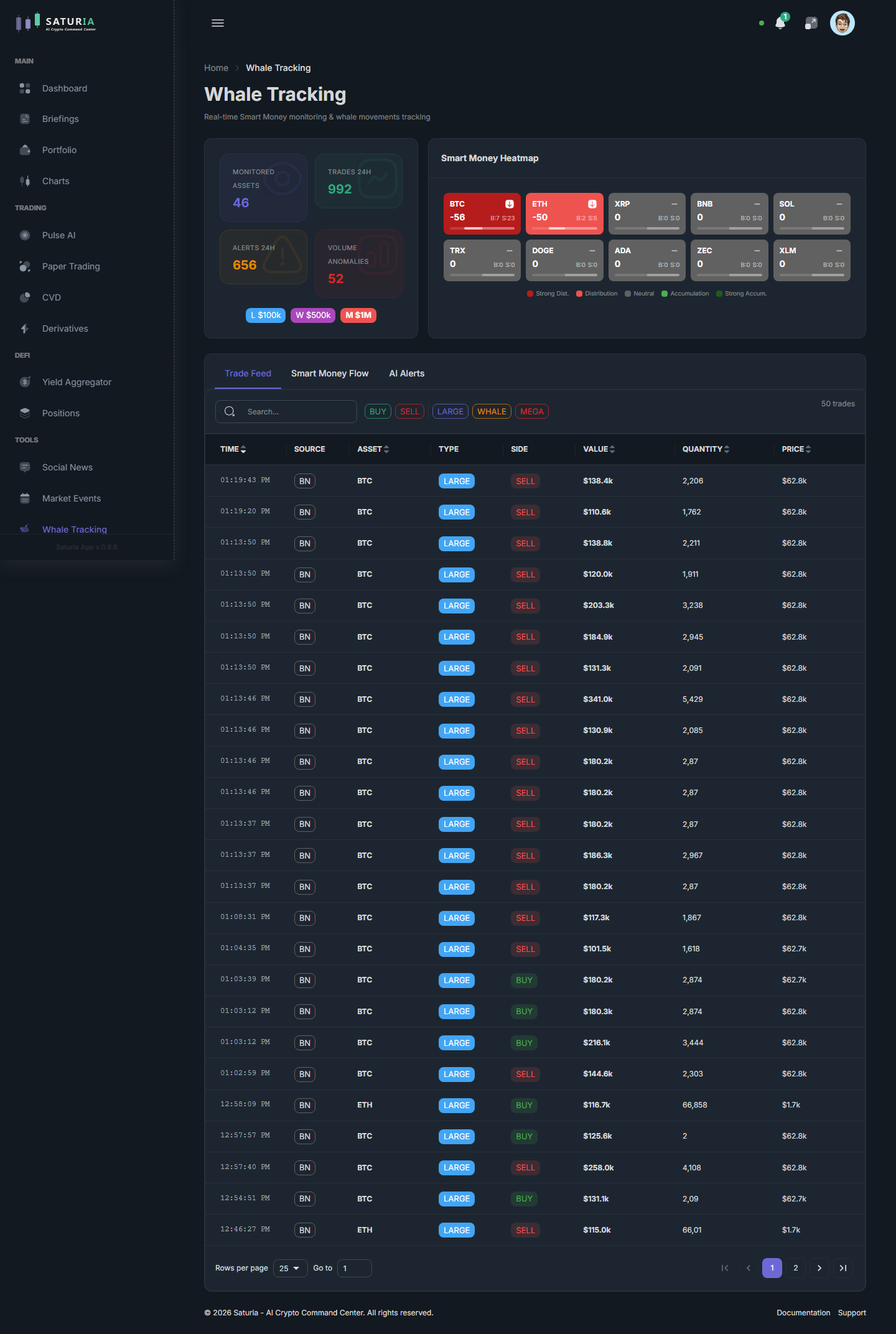
- You can enable or disable monitoring per asset from the Whale Tracking module.
- Whale alerts are delivered via the standard notifications system (in-app, email, Telegram).
In depth
Why track whales
A whale is a wallet that holds or moves enough of an asset to potentially influence the market. Following them isn't "copying the rich": it's using their actions as a leading signal of possible price movements. When a historically relevant wallet accumulates, the market often follows; when an exchange sees big inflows, potential selling pressure rises.
Global thresholds
Thresholds for what counts as a "whale" transaction are global, not per-user. This is deliberate:
- Avoids each user manually configuring values for every asset.
- Ensures consistency in displayed data and statistics.
- Simplifies system-level tuning.
Thresholds are calibrated per asset based on its liquidity, so they capture moves meaningful for that specific asset.
Per-asset toggles
Even if thresholds are global, you decide which assets to monitor. In the Whale Tracking module you can enable or disable tracking per asset. If you don't hold an asset and don't care about it, you can turn it off to reduce noise.
Alerts
Whale alerts are part of the unified notifications system. You configure channels (in-app, email, Telegram) from the profile's notifications tab, and you receive alerts on the assets you've activated in Whale Tracking.
How to read a whale alert
A single whale alert means little. To extract value, consider:
- Price context → is it in uptrend? Distribution?
- Relative volume → how big is this transaction vs daily volume?
- Timing vs events → is there an imminent event (unlock, listing)?
- Consistency with other sources → are there converging pulses or sentiment signals?
Common mistakes
- Reacting to every alert — you'll end up trading impulsively.
- Treating all whales the same — an exchange reorganizing moves huge numbers without meaning anything.
- Predicting precise timing — even when a whale accumulates, the market can take days or weeks to react.
Limits and evolving features
- Specific details of the module (history retention, supported channels, additional filters) can evolve with backend updates. Check the module directly for the current options.
- Whale tracking isn't an operating signal: it tells you where to look, not what to do.