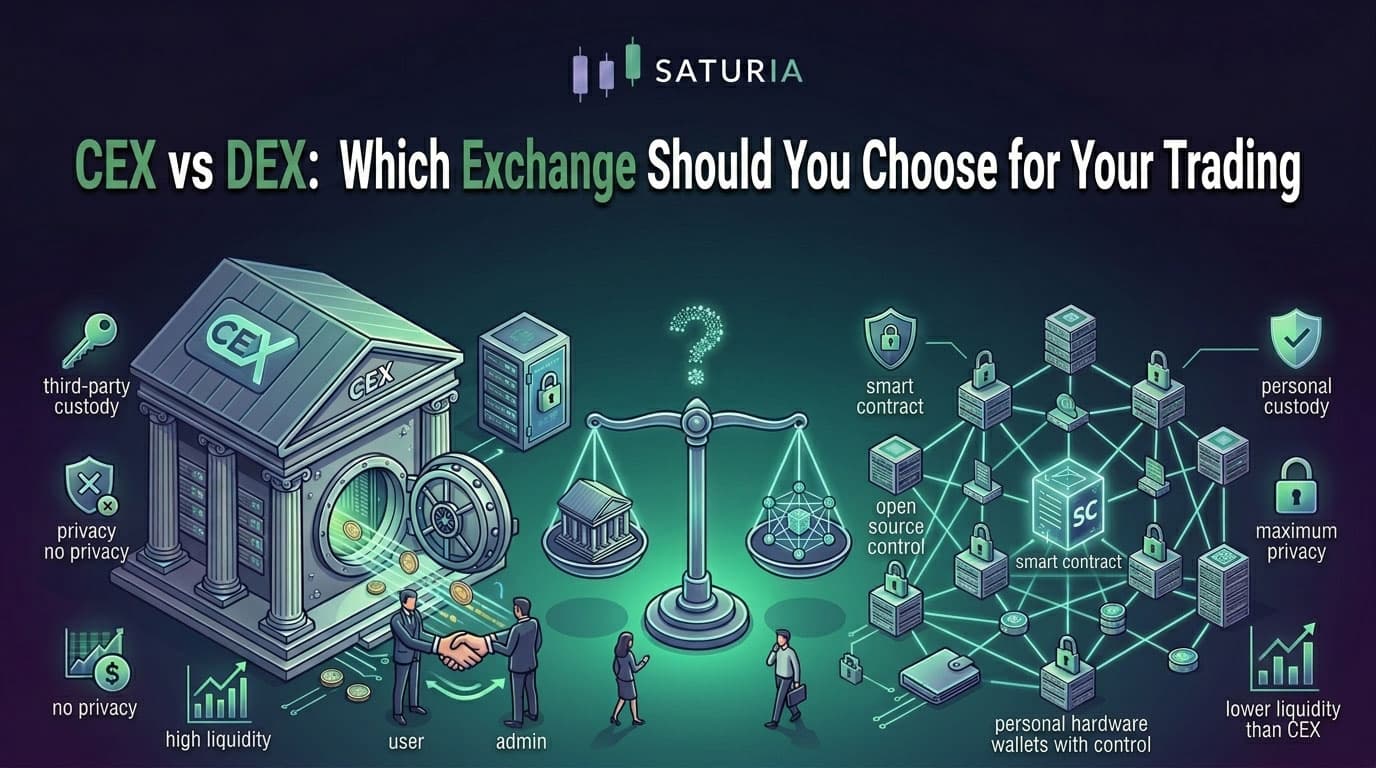
Centralized vs Decentralized Exchanges: Which to Choose and Why
If you're new to cryptocurrency, one of the first decisions you'll face is: where do I buy and sell my crypto?
You'll notice there are two main categories of exchanges: centralized (CEX) and decentralized (DEX). But what's the difference? Which should you choose? Which is safer?
In this comprehensive guide, we'll explore both models, analyzing pros, cons, costs, and when to use each.
What Are Centralized Exchanges (CEX)?
A centralized exchange (CEX - Centralized Exchange) is a platform managed by a central company or organization. The exchange acts as an intermediary between buyers and sellers.
Major CEX Examples
- Binance: Largest by volume worldwide
- Kraken: American, security-focused
- Coinbase: American, user-friendly, publicly traded
- OKX: Chinese, specialized in derivatives
- FTX (now defunct due to 2022 collapse)
How CEXs Work
When you use a CEX like Binance:
- Create an account and complete KYC (Know Your Customer) verification
- Deposit funds (fiat like EUR/USD or crypto)
- Place orders from the centralized order book
- The exchange custodizes your funds until you withdraw
The exchange holds your funds in custody, meaning your crypto assets are technically owned by the exchange until you withdraw them.
Advantages of CEX
1. Ease of Use
- Intuitive interface for beginners
- Well-developed mobile apps
- Simple registration process
2. High Liquidity
- Many traders on same platform
- Narrow bid-ask spreads (difference between buy and sell price)
- Orders executed quickly, even for large amounts
3. Execution Speed
- Near-instant transactions
- No need to wait for blockchain blocks
4. Easy Fiat Deposit
- Deposit directly from bank account
- Payment methods: credit cards, bank transfers, PayPal
- No need to understand blockchain
5. Additional Services
- Staking and yield farming
- Margin trading (leverage)
- Futures and derivatives
- Paper trading and simulations (on some platforms)
6. Customer Support
- Real support team
- KYC resolves disputes
- Insurance on some accounts
Disadvantages of CEX
1. Hack/Insolvency Risk
- Exchange is target for criminals
- If hacked, crypto could be lost (though rare insurance protects)
- If exchange fails (see FTX), your funds could disappear
2. Loss of Sovereignty
- You don't control your private keys directly
- Exchange could freeze your account without notice
- You must trust the exchange won't commit fraud
3. KYC and Privacy
- Must provide ID, address, sometimes selfie
- Centralize your data with the exchange
- Risk of data breach (your data could be sold)
4. Structured Fees
- Trading commissions (typically 0.1%-0.3% per order)
- Deposit/withdrawal fees
- Swap fees between pairs
5. Geographic Restrictions
- Some exchanges only operate in certain countries
- Local regulations can limit what you can do
6. Access Issues
- Maintenance and downtime during volatile periods
- When many people want to buy/sell, servers could crash
- Rate limiting
What Are Decentralized Exchanges (DEX)?
A decentralized exchange (DEX - Decentralized Exchange) is a smart contract protocol on blockchain that allows peer-to-peer trading without an intermediary.
Major DEX Examples
- Uniswap: Leading DEX on Ethereum
- SushiSwap: Uniswap fork
- PancakeSwap: DEX on Binance Smart Chain (BSC)
- Curve Finance: Specialized in stablecoins
- dYdX: Decentralized but with centralized components
How DEXs Work
Modern DEXs (like Uniswap) use the Automated Market Maker (AMM) model:
- Liquidity Pools: Instead of an order book, there are liquidity pools
- Liquidity Providers: Users deposit token pairs (e.g., ETH + USDC) and earn fees
- Mathematical Formula:
x * y = k- price is determined by ratio of tokens in pool - You trade directly with the pool, not with another trader
- Smart contract executes automatically, no intermediary
Advantages of DEX
1. Total Sovereignty
- You control your private keys
- Use your own wallet (MetaMask, Trust Wallet, etc.)
- Nobody can freeze your account
2. No KYC
- Start with just your wallet, zero personal information
- Nearly complete privacy
- Accessible from any country
3. No Custody
- Exchange doesn't hold your funds
- If exchange stops operating, your tokens stay in your wallet
- Zero insolvency risk
4. Censorship Resistant
- A DEX can't freeze your account
- Governments can't easily shut it down
- Decentralization = financial freedom
5. Reduced Costs in Some Cases
- DEX trading fees often lower (0.01%-0.3%)
- No deposit/withdrawal fees (just gas fees)
6. Access to New Tokens
- New tokens often list on DEX before CEX
- Early trading opportunities
- Impermanent loss aside, access everything
Disadvantages of DEX
1. Lower Liquidity (For Many Tokens)
- Wider bid-ask spreads
- Can be hard to swap large amounts without slippage
- Some tokens have very low liquidity
2. Slippage and Impermanent Loss
- Slippage: The price you receive might be worse than expected
- Impermanent loss for liquidity providers
- These mechanisms can reduce your returns
3. Gas Fees (Blockchain Transaction Fees)
- On Ethereum, transaction fees can be very high (sometimes $10-$100+)
- On layer 2 or other blockchains, lower but still present
- Each swap costs gas fees
4. Technical Complexity
- You must manage your own wallet and private keys
- If you lose your seed phrase, you lose everything
- If you make a mistake (wrong address), nobody recovers your funds
5. Smart Contract Risks
- Bugs in DEX code can cause losses
- Audits don't guarantee 100% security
- Flash loans and other vulnerabilities can be exploited
6. No Customer Support
- If something goes wrong, there's no company to contact
- If you make a mistake, it's your fault
- No insurance
7. Price Volatility in Pools
- Token price in DEX could differ significantly from CEX
- Arbitrageurs bring prices in line, but meanwhile you might get poor price
Head-to-Head Comparison
| Aspect | CEX | DEX |
|---|---|---|
| Liquidity | Very high | Variable (high for major, low for new) |
| Speed | Fast | Slow (depends on blockchain) |
| Trading Fees | 0.1%-0.3% | 0.01%-0.3% (+ gas fees) |
| KYC | Required | No |
| Control of Funds | Exchange | You (self-custody) |
| Hack Risk | High (exchange target) | Medium (smart contract) |
| Failure Risk | High | Low (decentralized) |
| Ease of Use | High | Medium-Low |
| Privacy | Low | High |
| Access From Anywhere | No (geographic restrictions) | Yes |
| Support | Present | No |
| Access to New Tokens | Slow | Fast |
How to Choose: CEX or DEX?
The answer is: it depends on your specific use case.
Use a CEX If:
- You want simple interface - You prefer customer support - You don't want to manage private keys
- You're a Beginner
- Depositing EUR or USD is easy on CEX - On DEX it's complicated (you need crypto already)
- You Want to Buy/Sell Crypto With Fiat
- High liquidity = best price - Fast execution essential - Bitcoin, Ethereum, stablecoins
- You're Actively Trading Major Pairs
- CEX offer leverage - DEX have fewer derivatives
- You Want Margin Trading or Futures
- CEX integrate staking easily - DEX is more complex
- You Want Simple Staking
Use a DEX If:
- Don't want to depend on intermediary - You're experienced with self-custody
- You Want Maximum Sovereignty
- No KYC - No tracking of your data
- You Want Maximum Privacy
- Brand new tokens just launching - Small projects not yet on CEX
- You Want Access to New/Rare Tokens
- You know how to manage wallets - You understand gas fees - You understand impermanent loss
- You Have Technical Skills
- Earn fees from commissions - Actively participate in DEX
- You Want to Contribute as Liquidity Provider
Hybrid Strategies: CEX + DEX
The smartest approach is using both:
Phase 1: Fiat → Crypto (CEX)
- Buy crypto with real money on a CEX (Binance, Kraken, Coinbase)
Phase 2: Strategic Accumulation (CEX or DEX)
Phase 3: Diversification (DEX)
- Move some crypto to DeFi wallet for earning
- Do yield farming for income
- Swap rare tokens on DEX
Phase 4: Governance (DEX)
- Participate in protocol governance
- Vote on important decisions
Security: CEX vs DEX
CEX Security
Pros:
- Insurance on some accounts
- Dedicated security teams
- Cold storage of funds
- If attacked, company is liable
Cons:
- If hacked, all users affected
- Insider job possible
- Regulatory compliance ≠ always secure
DEX Security
Pros:
- Your assets are in your wallet, not centralized
- If DEX is hacked, your tokens stay safe
- No single point of failure
Cons:
- Smart contract bugs = permanent loss
- You're responsible for seed phrase security
- Phishing attacks can steal your wallet
- Unlimited approvals to smart contracts = risk
Security lesson: Never approve unlimited amounts on a DEX. Only approve the amount you're swapping.
Future Trends: CEX and DEX Converge
The future will likely bring convergence:
- Decentralized CEXs (On-Chain OrderBooks): Like dYdX v4
- Simplified DEXs: Better UX, less technical
- Layer 2 Solutions: Reduced gas fees make DEX more feasible
- Hybridization: APIs connecting CEX and DEX
Monitoring Your Strategy
Whether using CEX, DEX, or both, monitor carefully:
- Portfolio Performance: With Saturia, you can monitor your portfolio cross-exchange
- Accumulated Fees: How much are you paying in commissions?
- Impermanent Loss (if using DEX): Are your LP positions profitable?
- Market Sentiment: Fear & Greed Index for trading decisions
Saturia supports integration with DeFi wallets, allowing you to monitor both CEX and DEX in one dashboard.
Conclusion: Not Binary Choice
The choice between CEX and DEX isn't binary. Most sophisticated traders:
- Use CEX to acquire and easily swap (fiat on-ramp)
- Use DEX for specific opportunities and yield farming
- Self-custody main funds
- Monitor everything from one platform
Starting with a CEX makes sense if you're a beginner. As you learn, discovering the DEX world, DeFi wallets, and decentralized finance will open new earning opportunities and control over your money.
With Saturia, you can manage and monitor cross-exchange strategies, set smart alerts, and make informed decisions about where and how to trade.
Discover which exchange is right for you and start trading crypto consciously with Saturia.