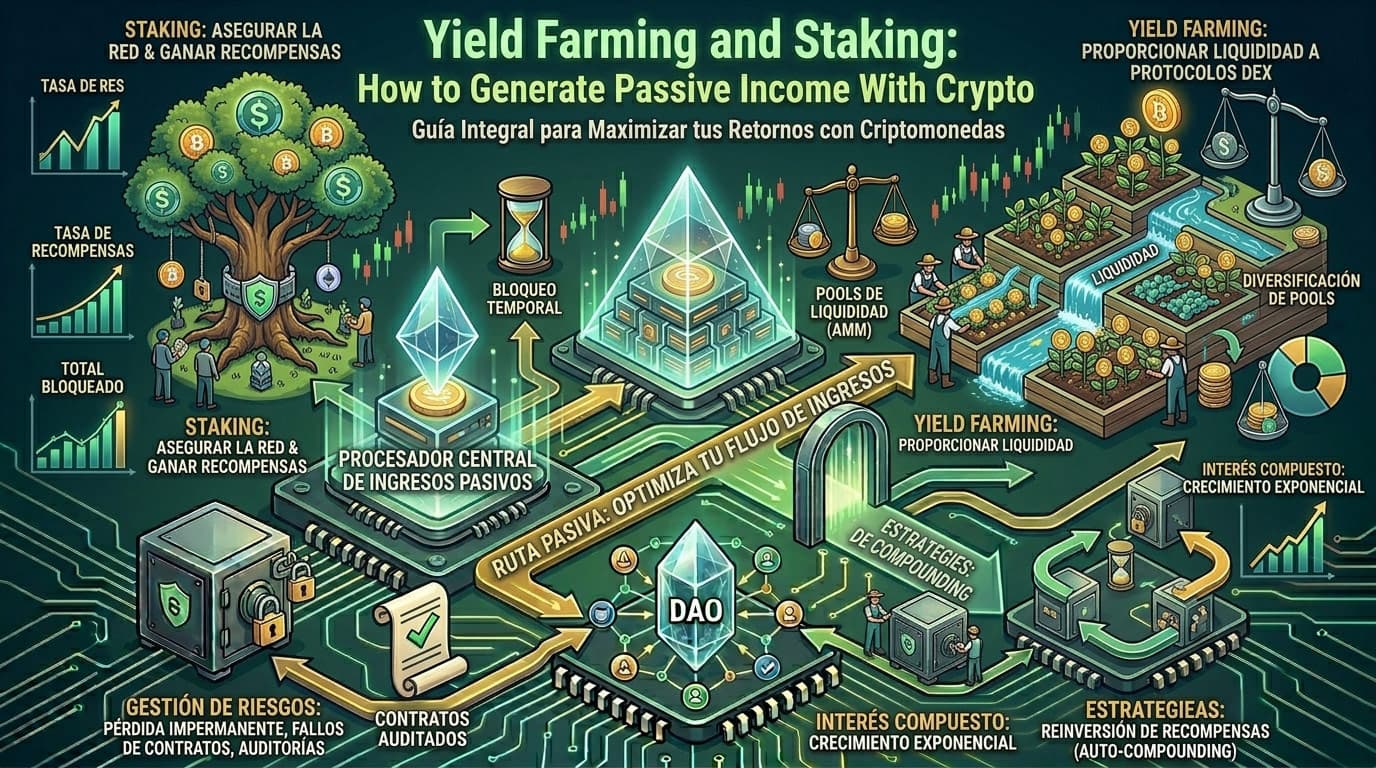
Yield Farming and Staking: How to Generate Passive Income With Crypto
One of the great advantages of the crypto ecosystem is the ability to generate passive income through your capital. Unlike traditional finance where bank rates are practically nonexistent, the world of cryptocurrencies offers significantly higher earning opportunities.
In this comprehensive guide, you'll discover what staking is, how yield farming works, the differences between APY and APR, and how to choose the best strategies to maximize your gains while minimizing risk.
What are Staking and Yield Farming?
Staking: Lock to Earn
Staking is the process of locking your cryptocurrencies in a smart contract to receive rewards. In return, you contribute to blockchain network security.
In Proof of Stake (PoS) blockchains like Ethereum 2.0, stakers validate transactions instead of miners. The network rewards this work with new tokens.
Practical example:
- You lock 10 ETH in a staking contract
- You receive 4% APY
- After one year, you have 10.4 ETH (plus any price variations)
- Your tokens remain locked during the staking period
Yield Farming: Provide Liquidity for Fees
Yield farming is the process of depositing token pairs into a liquidity pool to receive transaction fees and incentive tokens.
Unlike staking where you lock a single token, in yield farming:
- You deposit TWO tokens (e.g., ETH + USDC in 50/50 proportion)
- You receive LP tokens (Liquidity Provider) as a receipt
- You earn fees every time someone swaps in the pool
- You also receive bonus tokens from the protocol (incentives)
Practical example:
- You deposit 1 ETH + 2000 USDC into a Uniswap pool
- You receive UNI tokens (incentives) + 0.3% fees
- If 100,000 USDC are swapped in your pool, you earn ~300 USDC in fees
- At the end, you withdraw your funds plus earnings
Fundamental Differences Between Staking and Yield Farming
While both generate returns, they have very different characteristics:
Staking
| Aspect | Staking |
|---|---|
| Tokens Required | 1 type of token |
| Fund Locking | Generally yes (days to months) |
| Risk | Low (if reputable) |
| Return | Stable and predictable |
| Typical APY | 3% - 15% |
| Technical Requirements | Low |
Yield Farming
| Aspect | Yield Farming |
|---|---|
| Tokens Required | 2 tokens in proportion |
| Fund Locking | No (withdraw anytime) |
| Risk | Medium-high |
| Return | Variable and volatile |
| Typical APY | 10% - 500%+ |
| Technical Requirements | Medium-high |
APY vs APR: Understanding Return Rates
One of the most important concepts is the difference between APY and APR. Many beginners confuse them, but they're fundamentally different.
APR (Annual Percentage Rate)
APR is simple return without considering compounding.
Calculation: Annual return / Initial capital × 100
Example:
- You deposit 10,000 USDC with 10% APR
- Annual return = 1,000 USDC
- It doesn't matter if you reinvest the earnings or not, APR stays 10%
APY (Annual Percentage Yield)
APY is the ACTUAL return considering compounding (when you reinvest earnings).
Calculation: (1 + periodic rate)^periods - 1 × 100
Example:
- You deposit 10,000 USDC with 10% APR compounded monthly
- Month 1: 10,000 × 1.0083 = 10,083.33 USDC
- Month 2: 10,083.33 × 1.0083 = 10,167.89 USDC
- And so on...
- Final APY: ~10.47% (higher than the 10% APR)
Practical rule:
- APY > APR (always, when there's compounding)
- The more frequent the compounding, the greater the difference
- With daily compounding, APY is significantly higher than APR
What Should You Choose?
When you see an advertised return:
- If it's APY, consider it the maximum return with reinvestment
- If it's APR, your actual return will be lower if you don't reinvest
- Always compare APY with APY for correct decisions
How Yield Farming Works Step by Step
Imagine we're doing yield farming on Uniswap:
Step 1: Buy the Tokens
- Buy ETH and USDC in 50/50 proportion (e.g., 1 ETH + 2000 USDC)
Step 2: Access Uniswap
- Connect your wallet to uniswap.org
- Select "Pools" and "Create"
- Choose the ETH/USDC pair with fee tier (0.01%, 0.05%, 0.30%, 1%)
Step 3: Provide Liquidity
- Enter the amounts
- Approve transactions
- Pay gas (network fees)
- Receive LP tokens as a receipt
Step 4: Monitor Your Earnings
- Track accumulated fees in Saturia
- Monitor your position value
- Decide whether to reinvest or withdraw
Step 5: Withdraw Anytime
- Return to Uniswap
- Select your position
- Click "Remove liquidity"
- Receive your tokens back + earnings
Best Protocols for Staking and Yield Farming in 2026
For Staking
Ethereum (ETH)
- Stake ETH 2.0 to earn ~4% APY
- Minimum usually 0.1 ETH on Lido
- Risk level: Very low
Polygon (MATIC)
- ~3-4% APY on delegated staking
- Risk level: Low
Solana (SOL)
- ~5-8% APY
- Stakeable on wallets like Phantom
- Risk level: Low
For Yield Farming
Uniswap V3
- Concentrated liquidity for higher returns
- Various fee tier pools depending on risk
- Returns: 5% - 50% annualized (variable)
Curve Finance
- Specialized in stablecoin pools
- More stable returns: 5% - 20% APY
- Ideal for: those preferring lower volatility
Aave
- Lending platform with deposit returns
- Variable APY from 1% to 15% depending on token
- Security: Very high
Balancer
- Customizable pools with different weights
- Returns: 10% - 50% annualized
- More complex to use
Learn more about DeFi protocols
Advanced Strategies to Maximize Returns
Auto-Compounding
Automatically reinvest your earnings to benefit from compound returns.
Many protocols offer vaults that automate this process. For example:
- Yearn Finance automatically manages yield farming
- You receive passive returns without manual reinvestment
Diversification
Instead of putting everything in one pool:
- Distribute capital across 5-10 different pools
- Mix low risk (Curve) with higher opportunities (Uniswap)
- Balance stablecoins with altcoins
Staking + Yield Farming
Combine both strategies:
- Stake governance tokens (e.g., UNI, AAVE)
- Simultaneously do yield farming in different pools
- Diversify risk and returns
Risks You Need to Know
Impermanent Loss (IL)
This is the main risk of yield farming. If prices of tokens in the pool change drastically, you might suffer losses even if the pool remains profitable for the platform.
Read the complete guide to impermanent loss
Impermanent loss example:
- You deposit 1 ETH + 2000 USDC (assuming 1 ETH = 2000 USDC)
- ETH price rises to 4000 USDC
- The pool rebalances automatically
- When you withdraw, you have less ETH and more USDC
- You've "lost" the gain you would have had if you'd simply hodled ETH
Smart Contract Risk
If the protocol's code has bugs, your funds could be stolen. Risks decrease with:
- Independent security audits
- High TVL (more eyes watching the code)
- Established protocols over time
Rug Pull
Dishonest developers could disappear with funds. Protect yourself:
- Avoid new protocols without track record
- Check if developers are public
- Stay away from impossible returns (>100% APY from new tokens)
Price Volatility
If you provide liquidity with highly volatile altcoins, the risk of impermanent loss increases dramatically.
Monitor Staking and Yield Farming With Saturia
Saturia simplifies monitoring your DeFi positions:
- Portfolio Management: Track all your staking and yield farming positions in real time
- Alert System: Get alerts when your returns change significantly
- DeFi Wallet Integration: Connect your wallets and automatically view all earnings
- Price Tracking: Monitor token values in your pools to identify early warning signs of impermanent loss
Checklist to Get Started With Staking and Yield Farming
- Choose a DeFi wallet Read the guide
- Understand impermanent loss risk Learn more here
- Start with small amounts
- Choose a protocol with high TVL and good audits
- Split capital across at least 3 different positions
- Set up alerts in Saturia to monitor automatically
- Review your position at least weekly
Returns Calculator
To plan your earnings, consider this calculation for APY:
Final capital = Initial capital × (1 + APY)^years
Example with 10,000 USDC at 10% APY for 3 years:
- 10,000 × (1 + 0.10)^3 = 13,310 USDC
With frequent reinvestment (compounding):
- Even better results if you reinvest earnings monthly
Conclusion
Staking and yield farming represent the most direct way to generate passive income in the crypto world. With returns significantly higher than traditional finance, they offer unique opportunities.
The key is:
- Continuously educate yourself on the risks
- Start small as you learn
- Diversify capital across multiple positions
- Constantly monitor with tools like Saturia
With the right caution and knowledge, staking and yield farming can become crucial components of your crypto wealth-building strategy.
Start today with Saturia - your professional dashboard to manage all your DeFi positions in one place.