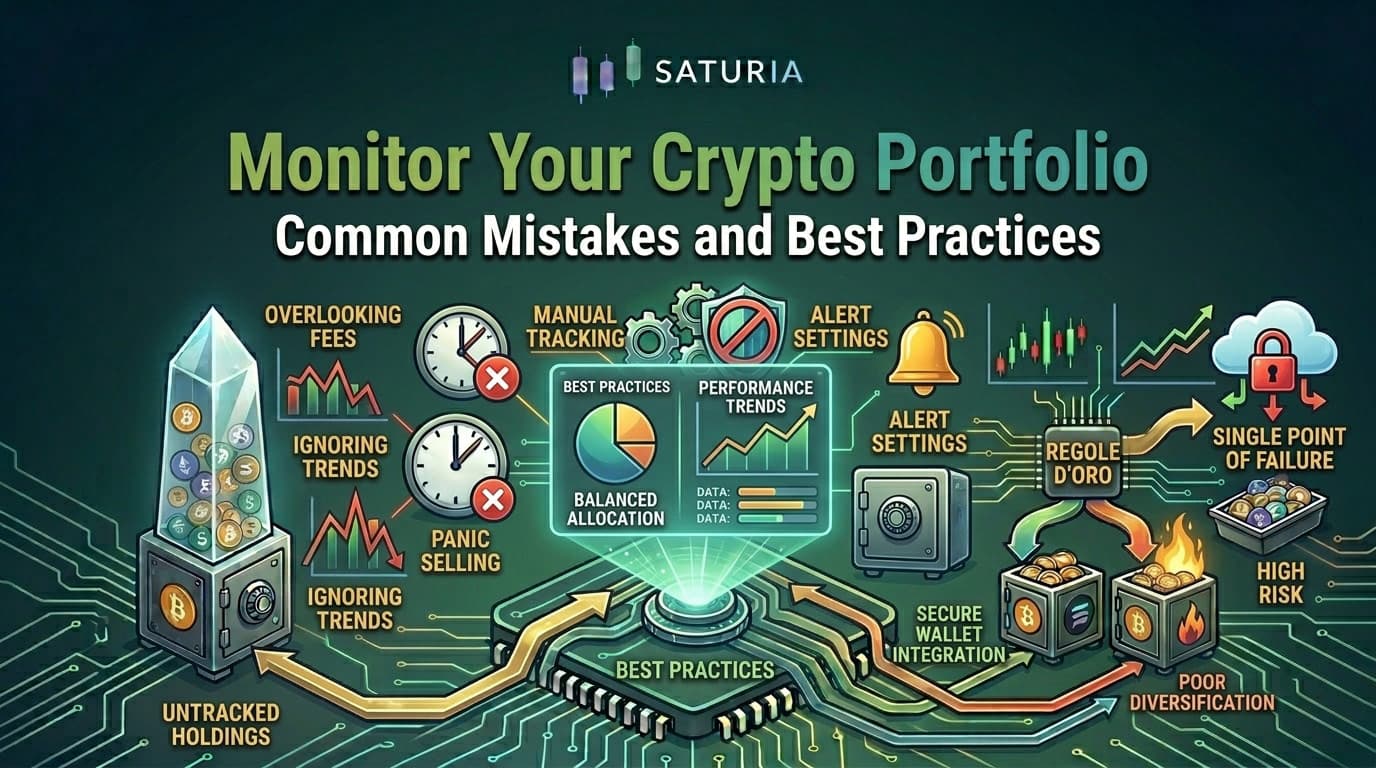
Monitor Your Crypto Portfolio: Common Mistakes and Best Practices
One of the most underrated aspects of crypto trading is systematic portfolio monitoring. While many traders focus on technical analysis and hunting for the next big altcoin, they overlook a fundamental element: truly understanding how their portfolio is performing.
It's not about obsessive compulsion. It's about awareness, control, and making informed decisions. In this article, we'll explore why portfolio monitoring is critical, what the most common mistakes are, and how to implement best practices that work over time.
Why Monitor Your Portfolio?
Before diving into mistakes and best practices, let's clarify the "why." What are the concrete benefits of regular monitoring?
1. Real Performance Awareness
Many traders have a vague idea of "how things are going" with their portfolio, based on feelings rather than data. Regular monitoring provides you with:
- Total return: what percentage have you gained or lost since your initial investment?
- Annualized return: if the trend continues, what would your return be on an annual basis?
- Relative performance: how is it performing compared to Bitcoin or the broader market?
- Volatility: has your portfolio become riskier or more stable?
These metrics allow you to assess whether your investment strategy is actually working.
2. Identify Operational Errors
Tracking each transaction helps you:
- Discover hidden fees eroding your returns
- Identify unprofitable trades you shouldn't repeat
- Evaluate whether your trading approach (scalping, swing trading, hodling) is actually profitable
- Recognize patterns in mistakes—for example, if you tend to buy near the end of bull runs
3. Tax Compliance
In almost every country, cryptocurrencies have tax implications. Monitoring your portfolio isn't just a financial best practice—it's a legal obligation. Without tracking, facing a tax audit on crypto becomes a nightmare.
4. Conscious Rebalancing
As discussed in our article on Bitcoin vs altcoins: allocation, periodic rebalancing keeps your portfolio aligned with your strategy. Without monitoring, you won't even know if you're unbalanced.
5. Psychological Control
Regular monitoring, when done correctly, reduces anxiety. Knowing exactly where you stand, what you own, and what your portfolio is worth eliminates the uncertainty that pushes many traders to irrational decisions.
The Most Common Portfolio Monitoring Mistakes
Mistake 1: Checking Your Portfolio Too Often
This is probably the most common mistake among crypto traders—especially beginners.
Opening your trading app every 5 minutes to check prices isn't "monitoring." It's obsession, and it damages both your mental health and your financial decisions.
The problem: Observing intra-day movements amplifies the perception of volatility and pushes toward emotional reactions:
- You see your portfolio down 3% in 30 minutes and panic
- You realize small losses out of fear of bigger ones
- You trade in response to noise rather than real signals
The solution:
- If you're a hodler: check your portfolio no more than once a week
- If you're a swing trader: once a day, preferably after market close (at a global level, this doesn't apply to crypto which operates 24/7, but you can choose a fixed time)
- If you're day trading: obviously you monitor continuously during trading sessions, but outside those hours, leave it alone
Set calendar reminders—not compulsive obsessions. Saturia lets you set specific alerts for significant movements, so you don't have to constantly check.
Mistake 2: Not Tracking Fees
Something strange happens psychologically here: traders meticulously track gains, but ignore how 2-3% in annual fees erodes those gains.
Real example:
- You invest $10,000
- After a year, your portfolio is worth $12,000 (20% return)
- You've paid $300 in exchange fees (3% of total trading volume)
Many traders count the 20% return and feel good, without realizing their net return was 17%. Over the long term, with compounding, those fees represent tens of thousands of dollars lost.
How to track fees:
- Download exchange statements (most provide CSV with all transactions)
- Include fees in the average cost calculation for each purchase
- Use spreadsheets or specialized tracking software (Bitcoin.tax, Koinly, etc.)
- Spend 15 minutes monthly syncing your exchange transactions with your tracker
Fees are particularly important if you use stablecoins for dollar-cost averaging or rebalance frequently on centralized exchanges.
Mistake 3: Ignoring Tax Implications
This might be the most expensive of the three mistakes.
Many traders don't realize that every crypto purchase/sale (or swap between cryptos) is considered a "taxable event" in most jurisdictions. If you made 100 trades in a year, you have 100 taxable events to report.
If you don't track:
- You can't calculate your taxes: at year-end you won't know your taxable gain
- You risk an audit: if tax authorities ask for an accounting, you'll have no documentation
- You pay more: without documentation, you can't prove your losses, which would reduce your taxable gain
Best practices:
- Download a cost basis report from Koinly, Bitcoin.tax, or similar software
- Keep a physical or digital copy of the report
- Consult an accountant who understands crypto
- In some countries (like Italy), crypto is subject to capital gains taxation at ordinary rates
Read our article on stop-loss and take-profit which includes considerations on tax costs.
Mistake 4: Not Distinguishing Between Gross and Net Return
Gross return is the "nice" number you see: if you buy at $100 and sell at $120, gross return is 20%.
Net return is what actually matters: $120 minus transaction fees, minus taxes. If you paid $3 in fees and will owe $3 in taxes when you realize the gain, your net return is 14%.
Many traders brag about gross return without understanding that their net return—what they actually keep—is much lower.
How to calculate net return:
- Sum the total acquisition cost (including fees)
- Subtract the sale price (excluding fees received)
- Sum the taxes owed (rough estimate if unrealized)
- Divide by the acquisition cost
This is your true return.
Mistake 5: Lack of Centralized Tracking
Many traders hold assets on multiple exchanges: BTC on Kraken, ETH on Binance, altcoins on Uniswap, stablecoins in a DeFi wallet.
Without a centralized tracking system, it's easy to:
- Lose track of where your assets are
- Underestimate your total portfolio
- Make allocation errors
- Pay incomplete taxes because you forget an exchange
Solution: Use a portfolio tracking app that syncs with all your exchanges and wallets. Saturia integrates tracking across multiple exchanges, allowing you to see your consolidated portfolio on a unified dashboard.
Mistake 6: Not Monitoring Realized vs Unrealized P&L
This is an important conceptual mistake.
Unrealized P&L: gains or losses on your current assets (based on current market price). If you bought ETH at $1,500 and it's now worth $2,500, you have unrealized P&L of +$1,000.
Realized P&L: gains or losses you've actually locked in through a sale. If you sell that ETH at $2,500, you realize the $1,000 gain (minus fees and taxes).
Many traders only look at unrealized P&L and feel rich until they sell—at which point they discover that taxes and fees have significantly reduced the gain.
Track both:
- Unrealized P&L → tells you how your allocation strategy is performing
- Realized P&L → tells you how much you've actually made from crypto trading
Mistake 7: Not Monitoring Portfolio Composition
If you allocated your portfolio following our article on Bitcoin vs altcoins, but don't monitor how the proportions change over time, your portfolio gradually drifts from your strategy.
If you allocated 70% Bitcoin and 30% altcoins, but Bitcoin grows faster, you might eventually have 80% Bitcoin. Your strategy has been modified without conscious decision.
Monitoring composition:
- Track the percentage of each asset (or asset category) in your portfolio
- Rebalance when proportions shift more than 10-15% from your target allocation
- Use spreadsheets or Saturia's tracking dashboard
Best Practices for Effective Monitoring
Now that we've identified the mistakes, let's see how to implement a monitoring system that works.
1. Appropriate Checking Frequency
Based on your trading style:
Long-term hodler/investor:
- Check portfolio once a week
- Rebalance once quarterly
- Review taxes once yearly
Swing trader (holding positions for days/weeks):
- Check portfolio every evening to assess positions
- Rebalance every 1-2 months
- Review taxes quarterly
Day trader:
- Monitor continuously during trading sessions
- Review consolidated portfolio every evening (for overall tracking)
- Calculate taxes weekly
2. Key Metrics to Track
Don't track everything—track what matters:
Essential:
- Total portfolio value (in a reference currency, preferably stablecoin)
- Realized vs unrealized P&L
- Percentage allocation (Bitcoin, top 10 altcoins, mid-cap altcoins, etc.)
- Fees paid in the period (daily, monthly, annual)
Important (if applicable):
- Annualized return
- Return vs a benchmark (e.g., Bitcoin)
- Days since you started this portfolio
- Average purchases (how much new money did you add each month?)
Optional:
- Daily volatility
- Correlation between assets
- Sharpe ratio (risk-adjusted return)
If you're new, start with the "essential" metrics and add complexity over time.
3. Recommended Tools
For basic tracking:
- Spreadsheets (Google Sheets, Excel): simple, flexible, but require manual work
- Saturia: integrated dashboard that syncs with exchanges and wallets, calculates allocation and alerts on significant movements
For tax compliance:
- Koinly: syncs with 500+ exchanges, calculates taxes for every jurisdiction
- Bitcoin.tax: similar to Koinly, focused on tax reporting
- CryptoTrader.tax: another reliable option
Remember: these tools don't replace an accountant, but they help you provide the data your accountant will need.
4. Monthly Monitoring Checklist
Here's a checklist to complete once monthly:
- Sync all your exchanges and wallets in your tracker
- Verify your total portfolio value
- Calculate gross P&L (without taxes/fees)
- Extract a fee report from your exchange
- Subtract fees from gross P&L to get net P&L
- Review portfolio composition (% BTC, % altcoins, etc.)
- Decide if you need to rebalance (generally no if you're within 10-15% of target allocation)
- Document new capital added (if applicable)
- Update your tax tracker (download exchange data)
This process takes 30-45 minutes monthly if well organized.
5. Monitoring Volatility
An often-overlooked but important metric is your portfolio's volatility. In our article on risk management in trading, we discuss how volatility affects your emotional stress and trading decisions.
How to measure:
- Track portfolio value on the same day each week (e.g., Monday 9am UTC)
- Calculate percentage change from the previous week
- Over 12 weeks, you'll have a sense of weekly volatility
- If volatility exceeds your comfort level, consider rebalancing toward less volatile assets
6. Use Smart Alerts
Don't check manually—let technology alert you when something significant happens.
Set alerts for:
- Significant movement (e.g., portfolio down 10%)
- Rebalancing (e.g., Bitcoin falls below 65% of target allocation)
- Specific asset (e.g., an altcoin falls below a threshold, or a whale makes a large move)
Saturia supports advanced alerts you can fully customize. This way you don't have to constantly check—you'll receive a notification only when there's something to be aware of.
Advanced Monitoring: Risk Management Metrics
If you're a swing trader or more active trader, consider these advanced metrics:
Sharpe Ratio
A metric that measures risk-adjusted return. A Sharpe ratio of 1.5 is considered very good. A simplified formula:
(Average weekly return - Risk-free return) / Standard deviation of return
If your Sharpe ratio is low, it means you're taking a lot of risk for little return—a sign that your strategy might need adjustment.
Maximum Drawdown
How far has your portfolio fallen from its peak to its worst point? If you started with $10,000, reached $15,000, then fell to $12,000, your maximum drawdown is -20% from peak.
Tracking this helps you understand your real risk profile versus the one you think you have.
Correlation With Bitcoin
If your portfolio is perfectly correlated with Bitcoin, you're not getting the benefit of diversification. Calculate monthly correlation between your portfolio and Bitcoin—if it's > 0.95, you're essentially buying altcoins that move identically to Bitcoin, which isn't diversification.
Read our article on balanced crypto portfolio for more insights on true diversification.
Conclusion: Monitoring as a Competitive Advantage
In crypto trading, most traders lose money not because their research is poor, but because they lack discipline. They don't follow a plan. They don't monitor results. They don't learn from mistakes.
Implementing a robust portfolio monitoring system won't guarantee profits, but it will:
- Give you awareness: you're not operating in the dark
- Keep you honest: data doesn't lie
- Reduce emotion: when you know the numbers, it's easier to decide rationally
- Save you from tax surprises: tracking everything protects you from hidden costs
Start simple. If you currently have no system, start with:
- A spreadsheet that tracks your portfolio value weekly
- A record of taxes on another sheet
- Your first month of monthly check-ins
Over time, as your portfolio grows, you can add complexity.
With Saturia, you have a tool that automates much of this work. The dashboard shows you allocation, P&L, and alerts, reducing the time needed for data gathering and letting you focus on the important strategic decisions.
Your crypto portfolio deserves to be monitored with the same care you'd dedicate to any other important investment. Don't start next month—start today.