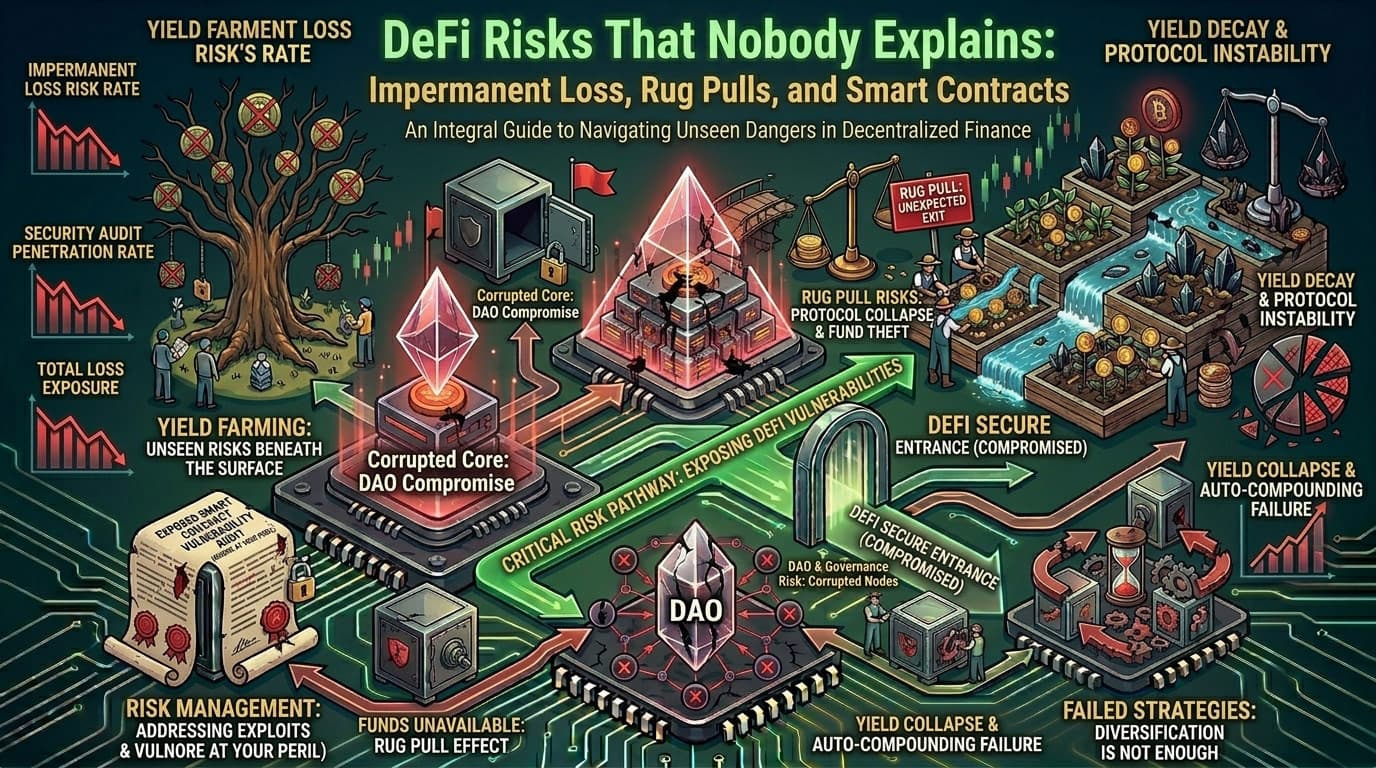
DeFi Risks That Nobody Explains: Impermanent Loss, Rug Pulls, and Smart Contracts
Decentralized finance offers extraordinary opportunities to generate passive income and achieve returns that far exceed traditional finance. But behind every opportunity lurk significant risks that many beginner traders underestimate.
Some of these risks are unique to DeFi and don't exist in traditional finance. In this in-depth guide, we'll analyze the main dangers in detail and show you how to protect your funds.
Impermanent Loss: The Silent Risk of Yield Farming
What is Impermanent Loss (IL)?
Impermanent loss is a theoretical loss you suffer when you provide liquidity to a pool and the token prices change significantly.
It's not a "real" loss because it remains unrealized until you withdraw your funds. It only becomes permanent when you close your position at adverse prices.
Practical Example of Impermanent Loss
Imagine the classic Uniswap ETH/USDC pool:
Initial situation:
- Deposits: 1 ETH + 2,000 USDC (1 ETH = 2,000 USDC)
- Total value: 4,000 USDC
- You receive LP tokens as a receipt
Scenario 1: ETH price rises to 4,000 USDC
If you had simply held your 1 ETH + 2,000 USDC:
- Value = 4,000 + 2,000 = 6,000 USDC
- Gain = 2,000 USDC (+50%)
But the pool rebalances automatically. When the price rises, Uniswap sells ETH and buys USDC to maintain constant value squared:
- You withdraw: 0.707 ETH + 2,828 USDC
- Total value = 2,828 + 2,828 = 5,656 USDC
- IL loss = 6,000 - 5,656 = 344 USDC (5.7%)
The loss could have been offset by:
- Trading fees accumulated in the pool
- Incentive tokens received from the protocol
If your fees > 5.7%, it's still profitable. If < 5.7%, you've lost money.
Impermanent Loss vs Returns
The approximate formula is:
IL % ≈ 2 × √(price ratio change) - 2
Or more simply:
| Price Change | IL % |
|---|---|
| 25% increase | ~0.6% |
| 50% increase | ~5.7% |
| 100% increase (2x) | ~20.1% |
| 200% increase (3x) | ~35.4% |
| 500% increase (6x) | ~63.2% |
Critical note: Impermanent loss is SYMMETRIC. Price increases and decreases create the same IL percentage, regardless of direction.
How to Minimize Impermanent Loss
1. Choose Low-Volatility Pools
- ETH/USDC: medium volatility
- USDC/USDT: very low volatility
- Volatile altcoins: maximum IL to avoid
2. Increase Fee Revenue
- Pools with higher fee tiers (0.30%, 1%) attract more trading
- More trading = more fees
- If fees > potential IL, it's worth it
3. Use Concentrated Liquidity Strategies
- Uniswap V3 lets you concentrate liquidity in specific ranges
- Increases fees earned
- But increases IL if price moves outside range
4. Monitor Your Position Continuously
- Use Saturia to receive price change alerts
- Withdraw if IL becomes excessive
- Reinvest if IL is covered by fees
5. Choose Stable Pairs if You Fear IL
- USDC/USDT/DAI have nearly zero IL
- Lower returns but very predictable
- Ideal if you want peace of mind
Learn more about yield farming
Rug Pull: When Developers Disappear With Your Money
What is a Rug Pull?
A rug pull is a fraud where crypto project developers:
- Attract investors with promises of impossible returns
- Accumulate liquidity from the project
- Suddenly disappear with the funds
It's like pulling the rug out from under your feet - hence the name.
How a Typical Rug Pull Works
Phase 1: Creation and Hype
- They launch a new token/protocol
- Promise astronomical returns (100%+ APY)
- Create vibrant community on Discord/Telegram
- Influencers and bots push the project
Phase 2: Attracting Liquidity
- Launch token on DEX with liquidity pool
- Encourage staking or yield farming
- Price rises rapidly
- Many investors FOMO in
Phase 3: The Disappearance
- Developers withdraw all liquidity from the pool
- Price crashes to zero in seconds
- Investors left with worthless tokens
- Funds disappear into anonymous wallets
Alarming Statistics
Research shows up to 90% of new DeFi tokens in 2024 were potential rug pulls. Not all execute the attack, but the risk is enormous.
How to Protect Yourself From Rug Pulls
1. Avoid New Tokens Without Track Record
- Wait at least 3-6 months before investing
- Observe the project from a distance
- Verify if developers are public
2. Check for Locked Liquidity
- On Uniswap, click "Pool" and search for the project
- If liquidity is "locked" for years, that's a good sign
- If it's unlocked tomorrow, run
3. Analyze the Team
- Research developers on LinkedIn
- Do they have previous crypto track record?
- Are they publicly identifiable?
- Previous successful projects?
4. Read the Code (If You Can Program)
- Functions that withdraw liquidity are critical
- Search for suspicious "emergencyWithdraw" functions
- Check if the creator has special access
5. Use Analysis Tools
- Rugscreen.com scans smart contracts
- TokenSniffer analyzes for red flags
- Honeypot.is verifies if the token is sellable
6. Golden Rule: If It Looks Too Good, It's a Trap
- 500% APY? Impossible
- 100%+ guaranteed returns? Rug pull
- Promises to "revolutionize Web3"? Scam
- If something looks too good, it's because it is
Smart Contract Risk: The Code Could Have Bugs
What Are Smart Contract Bugs?
Smart contracts are programs that live on the blockchain. If they contain errors, hackers can exploit them to steal funds.
Famous Historical Examples
TheDAO Hack (2016)
- Code vulnerability allowed $50 million to be stolen
- Bug was in the "reentrancy" function (recursive calls)
- First major hack in crypto history
Curve Finance Hack (2023)
- Oracle manipulation caused losses of 10+ million
- Attackers manipulated token prices
- Even large protocols are vulnerable
Ronin Bridge Hack (2022)
- $625 million in ETH stolen
- Bridge between blockchains had security bugs
- One of the largest crypto thefts in history
How to Evaluate Smart Contract Risk
Low Risk:
- Protocols with independent audits from recognized firms (OpenZeppelin, Certora)
- TVL > $1 billion (more eyes watching the code)
- Operating for > 3 years without incidents
- Examples: Uniswap, Aave, Curve
Medium Risk:
- Protocols with partial audits
- TVL $100 million - $1 billion
- Operating for 1-3 years
- Examples: Balancer, Lido, Yearn
High Risk:
- No independent audit
- TVL < $100 million
- Operating for < 1 year
- Unidentifiable team
- Anywhere you see these signals, avoid
Oracle Manipulation: The Manipulated Price
What is an Oracle?
An oracle is a mechanism that provides external data to the blockchain (like a token's price). Smart contracts use this data to make decisions.
How is it Manipulated?
If the oracle relies on a single source (centralized DEX), an attacker can:
- Borrow a large amount of a token (using a flash loan)
- Massively buy the token on the DEX, manipulating the price
- The manipulated price is used by a lending protocol
- The attacker borrows funds at artificial prices
- Repays the flash loan and keeps the profit
Example
- Flash loan of 10 million USDC
- Buy the USDC/DAI pool on SushiSwap massively
- DAI price crashes artificially
- A lending protocol uses the manipulated price
- You borrow 20 million USDC backed by 30 million DAI (at manipulated price)
- Repay flash loan
- Profit = savings on collateral needed
How Protocols Protect Themselves
- Chainlink oracle: Price determined by dozens of independent nodes (very secure)
- TWAP (Time-Weighted Average Price): Average prices over the past minutes (resistant to short-term manipulation)
- Multiple sources: Combine data from multiple DEXs
- Pauses: Pause transactions if price looks anomalous
Exploits and Hacking: Losing Funds in Compromised Protocols
Difference Between Bugs and Exploits
- Bug: Unintentional error in code
- Exploit: Deliberate use of a bug to steal funds
How Exploits Happen
- Hacker discovers a vulnerability
- Extracts a flash loan
- Exploits the bug
- Realizes enormous profits in a single transaction
- Before anyone notices, funds are gone
Protection From Exploits
- Insurance protocol: Nexus Mutual insures against hacks (but has limits)
- Stay updated: Follow official protocol channels
- Rapid exits: If you see vulnerability news, exit immediately
- Diversification: Don't put everything in one protocol
Yield Chasing and False Promises
The Problem of "Yield Chasing"
Many traders chase the highest returns without considering risk:
- New protocol with 1000% APY
- No audit
- Anonymous team
- Low TVL
- Maximum RISK
Calculating Real Risk-Return
If a protocol has:
- 100% APY
- 50% probability of rug pull
Expected return = (100% × 0.5) + (-100% × 0.5) = 0%
It's not worth ignoring risk.
The Rule of Sustainable Returns
Sustainable long-term returns:
- APY 3-8%: Stable protocols, low risk (Aave, Curve stablecoins)
- APY 8-20%: Moderate risk, established protocols (Uniswap fees, Lido)
- APY 20%+: Very risky, needs new capital to sustain
If you see 500% perpetual APY, it's an illusion. The numbers don't add up.
Systemic Contagion: Cascading Crashes
What is Systemic Contagion?
When a large protocol collapses, it causes others that depend on it to collapse too.
Example: Three Arrows Capital Collapse (2022)
- 3AC (major crypto fund) fails
- It borrowed from Celsius and Voyager Digital
- They also fail
- Luna/Terra collapses simultaneously
- Domino effect: 100+ billion in losses
How to Protect Yourself
- Don't put everything in a single protocol
- Monitor the financial health of protocols
- Distribute risk across at least 5-10 different protocols
- Keep some funds in liquid stablecoins
Regulatory Risk
What Could Happen?
Governments might:
- Ban certain protocols
- Implement higher taxes
- Require widespread KYC
- Prohibit certain tokens
How to Prepare
- Monitor regulatory news
- Maintain geographic diversification
- Don't operate only on tokens from a single country
- Understand tax implications
How Saturia Helps You Monitor Risks
Saturia provides tools to identify and mitigate DeFi risks:
- Risk Dashboard: Identify positions with high impermanent loss risk
- Smart Contract Monitoring: Alerts if a protocol has known vulnerabilities
- Rug Pull Detection: Analyzes new tokens for rug pull signals
- Oracle Price Tracking: Monitors price anomalies indicating manipulation
- Portfolio Diversification Alerts: Warnings if you're overexposed to a single protocol
- Liquidation Risk Monitor: Notifications if you're close to liquidation on lending protocols
DeFi Risk Protection Checklist
- I understand impermanent loss risk
- I don't invest in tokens < 3 months old without audit
- I verify that liquidity is locked for at least 1 year
- I diversify across at least 5 different protocols
- I monitor continuously with Saturia
- I read official team announcements
- I don't FOMO on impossible returns
- I keep some funds in stablecoins
- I know how to exit positions quickly
- I store seed phrases and private keys securely
Conclusion
DeFi is extraordinary but dangerous. The risks are real and numerous. Many traders lose money because:
- They don't understand the risks
- They ignore warning signs
- They chase impossible returns
- They don't diversify sufficiently
- They don't monitor continuously
The Golden Rule of DeFi: > If the promised return sounds too good to be true, it's because it is.
With education, caution, and continuous monitoring using tools like Saturia, you can navigate DeFi relatively safely and build sustainable passive income over time.
Start today with Saturia to monitor DeFi investment risks with advanced dashboards and real-time alerts.