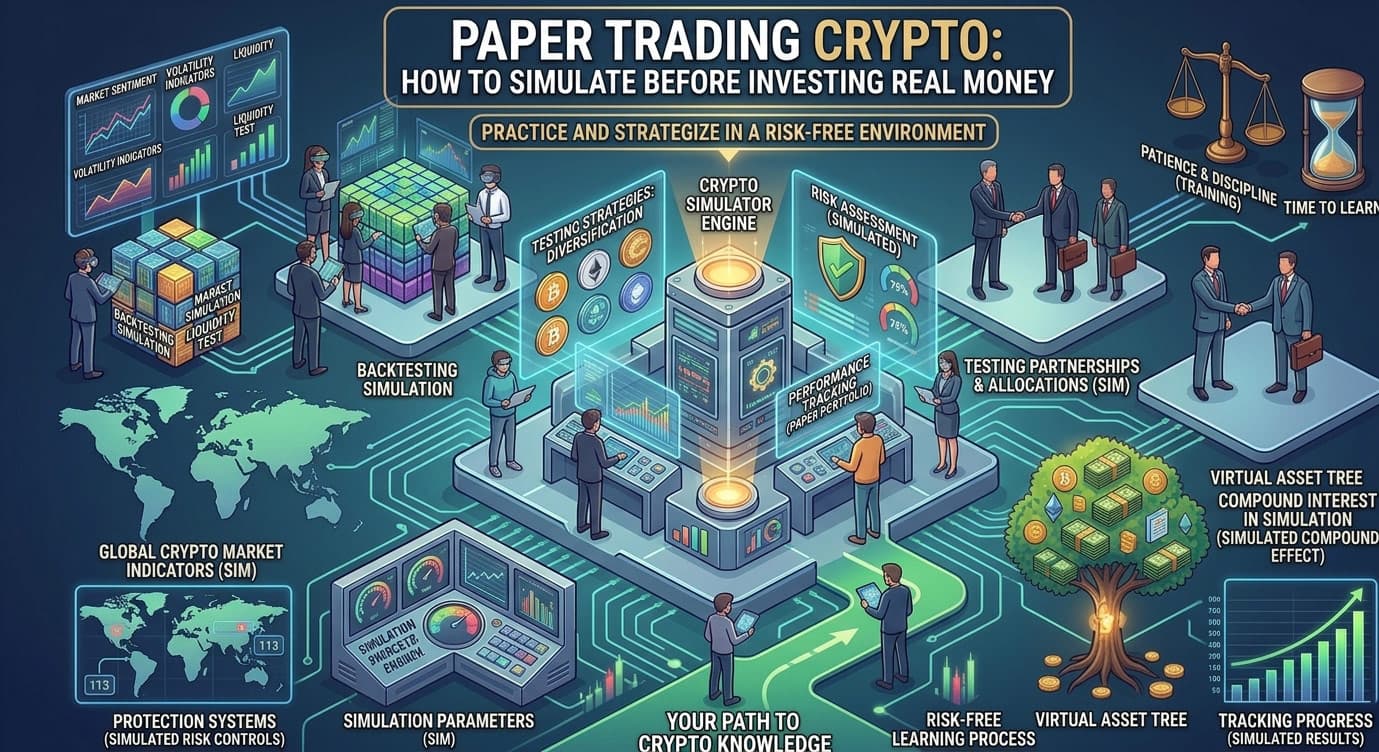
Paper Trading Crypto: How to Simulate Before Investing Real Money
Introduction
The transition from dreaming about becoming a cryptocurrency trader to making it a reality can be daunting. You've read fascinating articles about Bitcoin, you've been captivated by the latest crypto market trends, but when it comes time to invest real money, fear and uncertainty take over.
This is where paper trading comes in: a fundamental practice that separates successful traders from those who burn through their capital in weeks.
Paper trading (or virtual trading) is a form of simulated trading where you don't invest real money. It's like training in the gym before a big competition, or doing flight simulations before piloting a real plane. For crypto trading, it's essential.
What is Paper Trading?
Paper trading is a form of simulated trading in which you operate a demo account with virtual funds. Every action you'd take in a real account—buying Bitcoin, selling Ethereum, setting orders—happens exactly the same way, but without real money.
The crucial difference? Zero financial risk, maximum learning.
When you operate with fake money, every mistake becomes a free lesson. When you enter a wrong position, you lose nothing of value. This safe environment allows you to:
- Test trading strategies without financial consequences
- Understand how orders work (limit, market, stop-loss)
- Learn to read charts without anxiety
- Develop fundamental mental disciplines
- Understand how trading platforms work
Why Paper Trading is Crucial for Beginners
The Problem of the Learning Curve
Learning crypto trading is like learning to drive. It wouldn't make sense for an absolute beginner to take the wheel of a Ferrari at 200 km/h on the highway during rush hour. Yet many beginners do exactly that in crypto trading: they invest significant amounts without any practical experience.
The statistics are disheartening. A report from eToro revealed that 90% of retail traders lose money. One of the main reasons? They don't practice before risking real capital.
Developing Mental Discipline
Paper trading teaches you more than just how to click buttons. It teaches you how to control your emotions. Trading psychology is 90% of the game.
When you notice that even with fake money you tend to:
- Panic sell when the price drops
- Chase rapid and irrational gains
- Violate your own stop-loss rules
- Operate without a clear plan
...you'll realize that your real enemy isn't the market, but yourself.
Paper trading gives you the chance to identify these flaws without paying for them.
Test Strategies Without Consequences
Not all strategies you read on the Internet work for you. What works for a professional trader might be disastrous for a beginner with a different style.
With paper trading you can test:
- Technical analysis strategies
- Dollar-cost averaging (DCA)
- Stop-loss and take-profit
- Short-term trading vs holding
- Portfolio diversification
You'll quickly identify which strategies fit your profile, risk tolerance, and temperament.
How Paper Trading Works on Saturia
Saturia offers a complete virtual portfolio feature that perfectly simulates real account conditions:
Virtual Portfolio
You get a virtual portfolio preloaded with simulated funds. You can operate exactly as you would with real money:
- Buy and sell cryptocurrencies
- Monitor performance in real-time
- Set orders with stop-loss and take-profit
- See the impact of fees and slippage
Real-Time Market Data
The data is the same as the real market. You're not operating on artificial or delayed prices. This means your paper trading results are reliable and representative of what would happen in real trading.
Performance Tracking
Saturia metrics all your trades:
- Win rate (percentage of winning trades)
- Total and percentage profit/loss
- Maximum drawdown
- Average time held in position
This data is essential for understanding your trading style and identifying areas for improvement.
Seamless Transition
When you're ready for real trading, switching from paper trading to a real money account on Saturia is immediate. All the skills, experience, and disciplines you've developed transfer directly.
The Psychology of Paper Trading: Learning Without Blood
One of the biggest psychological advantages of paper trading is that it neutralizes fear.
Fear is the feeling that causes most trading mistakes:
- Closing winning positions too early out of fear of losing them
- Refusing to open positions because you're afraid of losing
- Adding capital after a loss in a desperate attempt to recover
In paper trading, you can experience stressful market scenarios—a -30% correction, 5 consecutive losing trades—in an environment where nothing of real value is at risk. When you face these situations with real money later, they won't seem new or frightening.
Familiarity reduces fear. Reduced fear means better decisions.
How Much Time Should You Spend Paper Trading?
The most frequent question is: "When can I switch to real trading?"
There's no universal answer, but here are some indicators:
Minimum Recommended: 2-4 Weeks
If you trade 5 days a week (market days) for 2-4 weeks, you'll have enough experience to understand the fundamentals. This is the absolute minimum.
Ideal: 1-3 Months
Three months of paper trading gives you exposure to different market cycles, allowing you to see how your patterns perform in various scenarios.
Personal Evaluation
Before switching to real money, ask yourself:
- Am I consistent? Have I followed my plan in at least 90% of my trades?
- Do I have a plan? Do I have a documented strategy for entry, exit, sizing, and risk?
- Do I understand my mistakes? Can I identify and learn from my errors in paper trades?
- Am I emotionally stable? Can I operate without anxiety when the price moves against me?
If you can answer "yes" to all these questions, you're ready.
If the answer is "no", keep practicing. There's no rush to switch to real money.
Paper Trading vs. Real Trading: Important Differences
Although paper trading simulates real trading very well, there are some differences to consider:
Slippage
In paper trading, you often get filled at the exact price when you place an order. In real trading, especially with market orders on more volatile cryptocurrencies, the price might slip. Saturia simulates realistic slippage to give you better preparation.
Fees
Real fees depend on the exchange and your volume. In paper trading on Saturia, fees are accurately simulated, so when you see your net profit, it reflects reality.
Liquidity
On some limit orders in less liquid cryptocurrencies, you might not get filled in the real market. In paper trading, orders always fill. It's a small difference, but something to keep in mind.
Learning From Your Paper Trades
The real value of paper trading isn't just in the number of trades, but in the review and learning process.
Every week, you should:
- Review all your trades: Why did you open them? What worked? What didn't?
- Document lessons: Keep a trading journal, even digitally
- Identify patterns: What types of trades tend to win? Which lose?
- Optimize your strategy: Based on what you learn, refine your strategy
This is the recipe for turning paper trading from a simple game into a real educational tool.
When Paper Trading Becomes Counterproductive
There comes a point when continuing paper trading too long becomes counterproductive. If you:
- Have been trading for 6+ months with consistent paper trading results
- Have tested your strategy across different market cycles
- Feel comfortable with the fundamentals
...continuing paper trading can become a form of procrastination. You're no longer learning, you're just postponing the real challenge.
At some point, you need to jump. With small amounts, of course. But you have to do it to truly grow.
Responsible Transition to Real Trading
When you switch from paper trading to real money, consider these steps:
1. Start Small
Your first real account doesn't need to be large. Many professional traders suggest starting with 1-5% of the total capital you intend to use for trading. This allows you to make transition mistakes without catastrophic consequences.
2. Use the Same Strategy
Don't change your strategy when you switch to real money. Use exactly the same one you tested in paper trading. The temptation to "go big" or change approaches is very strong, but it must be resisted.
3. Continue Monitoring
On Saturia, you can monitor your portfolio in real-time and receive alerts for important positions. Use these tools from day one.
4. Continuous Documentation
Continue maintaining your trading journal even with real money. It becomes even more important.
Conclusion
Paper trading isn't a shortcut to getting rich in crypto trading. It's not the path to the quick gains you'll hear promised in online forums.
What paper trading really is: the responsible path to competent trading.
It's practice without consequences that transforms theoretical strategy reading into practical understanding. It's the tool that separates traders who build wealth over time from traders who lose it in weeks.
If you're starting your crypto trading journey, the best first step isn't opening a real account. It's opening a paper trading account on Saturia, setting up your virtual portfolio, and starting to learn without risk.
When you finally decide to trade with real money, you'll do it from the right place: aware, disciplined, and prepared.
Happy simulating.