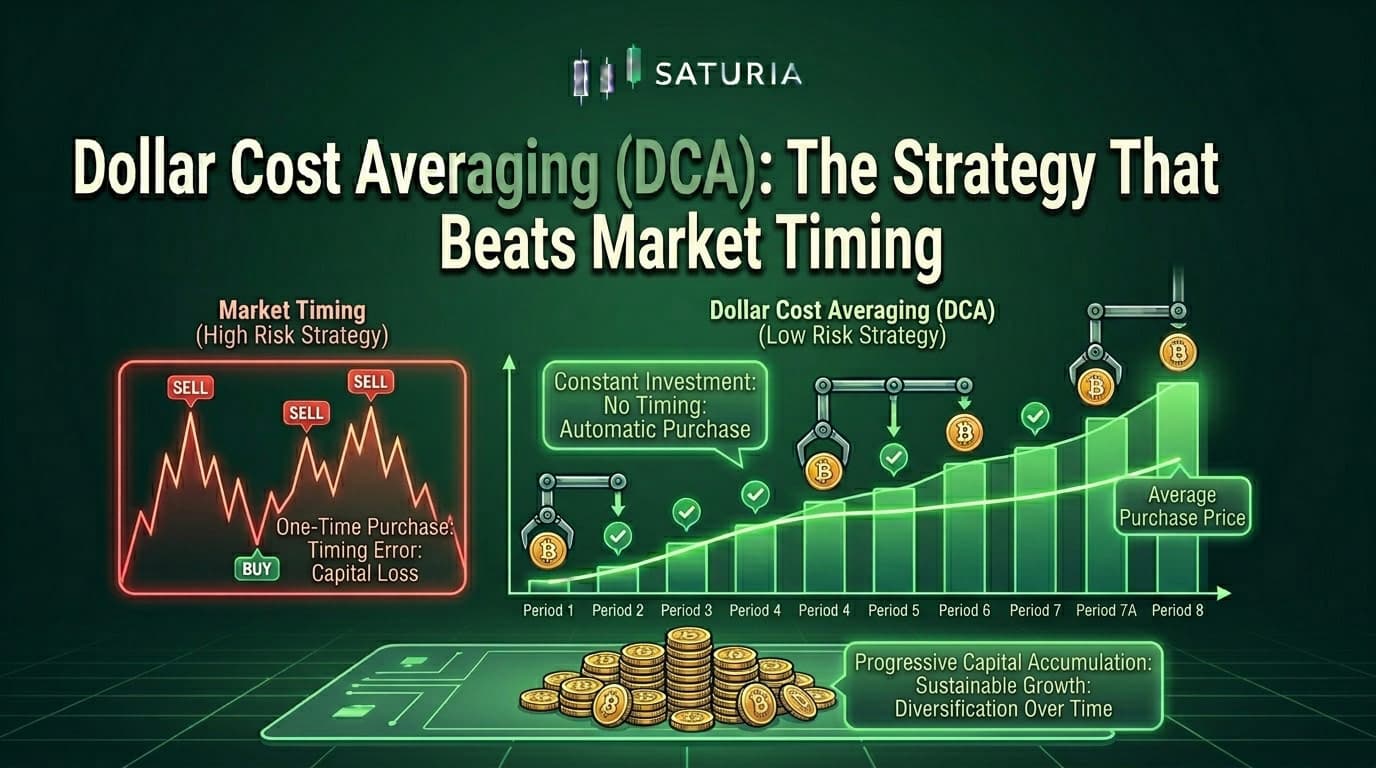
Dollar Cost Averaging (DCA): The Strategy That Beats Market Timing
If there's one strategy that guarantees the most wins for the least mental effort in crypto, it's Dollar Cost Averaging (DCA).
It's not flashy. It won't make you 50% in a week. But it's proven, mathematically sound, and works for 99% of investors. While others torture themselves looking for the perfect time to buy, you quietly accumulate over time and watch your portfolio grow consistently.
In this guide, I'll show you exactly what DCA is, why it works, how to implement it, and how it has historically generated superior returns compared to attempts at "market timing."
What Is Dollar Cost Averaging?
Dollar Cost Averaging (DCA) is simply this: invest a fixed amount of money at regular intervals, regardless of the current asset price.
Instead of investing €10,000 in Bitcoin today hoping the price rises, you:
- Invest €1,000 monthly for 10 months
- Or €500 every two weeks
- Or €100 every week
The beauty of DCA is that it completely eliminates the timing problem. You don't have to worry about whether the price is about to rise or fall. You simply continue investing the fixed amount, and the market takes its course.
The Bus Analogy
Imagine waiting for a bus that changes price every day:
- Day 1: €2 per ticket
- Day 2: €3
- Day 3: €1.50
- Day 4: €2.50
If you buy 1 ticket per day (DCA):
- Spend €2 on day 1 (1 ticket)
- Spend €3 on day 2 (1 ticket)
- Spend €1.50 on day 3 (1 ticket)
- Spend €2.50 on day 4 (1 ticket)
- Total spent: €9 | Total tickets: 4 | Average price: €2.25
If instead you wait for day 3 thinking it's the low and buy 4 tickets at once:
- Spend €6 (4 × €1.50)
- Then the price rises to €3 and you're furious you didn't buy on day 4 too
DCA protects you from bad timing decisions. It's almost impossible to lose significant money with DCA on an asset that rises long-term.
Why DCA Works Mathematically
DCA works because it exploits a fundamental mathematical property: when prices are low, you buy more units; when prices are high, you buy fewer units.
Detailed Numerical Example:
Scenario: Invest €1,000 monthly in Bitcoin for 6 months
| Month | BTC Price | Investment | BTC Purchased |
|---|---|---|---|
| 1 | €30,000 | €1,000 | 0.0333 |
| 2 | €35,000 | €1,000 | 0.0286 |
| 3 | €25,000 | €1,000 | 0.0400 |
| 4 | €28,000 | €1,000 | 0.0357 |
| 5 | €32,000 | €1,000 | 0.0313 |
| 6 | €40,000 | €1,000 | 0.0250 |
| Total | - | €6,000 | 0.1939 BTC |
DCA average price: €6,000 ÷ 0.1939 = €30,945
Notice something? Even though the final price (€40,000) is above the average, your average purchase price is €30,945, not €30,000 (the first price) or €40,000 (the last).
Now compare with "Lump Sum" (buying everything at once):
Scenario: Invest €6,000 in month 1 at €30,000
- Purchase: 6,000 ÷ 30,000 = 0.20 BTC
- Average purchase price: €30,000
If the price falls to €25,000, DCA (0.1939 BTC) fares better because it bought at different prices. If the price rises to €40,000, lump sum (0.20 BTC) gains more in absolute terms... but both win. DCA simply wins "less," but with far less stress.
The Statistical Advantage
Academic research (including a Vanguard study) has shown that:
- Lump sum outperforms DCA in 66% of cases
- But DCA has much lower variance (less downside risk)
- DCA wins in 34% of cases, often during major crashes
In other words, lump sum is slightly superior on average, but DCA has lower losses in bad scenarios. For those who can't emotionally tolerate a 30% loss in the first month, DCA is psychologically superior.
DCA vs Lump Sum: Which Strategy When?
Use Lump Sum If:
- You have a large sum in cash that "feels wrong" not to invest
- You can emotionally tolerate a 30-40% immediate loss
- You consciously entered at the "top"
- Your time horizon is >10 years
- Your strategy is pure hodling
Example: You receive an €100,000 inheritance. Investing it all at once, even with bad timing, is probably better than leaving it in cash.
Use DCA If:
- You have regular monthly/salary income you want to invest
- You're emotionally sensitive to losses
- You want to eliminate timing risk
- You're a beginner wanting to build confidence
- You're a passive investor wanting simplicity
- Your time horizon is 3-7 years
Example: You decide to invest 10% of your monthly salary in crypto. DCA is perfect.
DCA in the Real World: Historical Data
Let's analyze a real historical case: Bitcoin from 2017 to 2024.
Scenario 1: Lump Sum in January 2018 (the peak)
- Price: €11,000 (just after December 2017's €19,000 peak)
- Investment: €12,000
- BTC purchased: 1.09 BTC
- March 2024: price ~€40,000
- Gain: 270% (~€33,000 profit)
Yes, even someone who bought literally at the 2017 peak made enormous profits within 6 years. But the journey was terrible—in 2018 he was down 50%, and recovery took 3-4 years.
Scenario 2: DCA from January 2018 to December 2024 (€100/month)
- Total investment: €8,400 (84 months × €100)
- BTC purchased: ~0.38 BTC (average price ~€22,000)
- March 2024: price ~€40,000
- Gain: 73% (~€6,100 profit)
Interesting, right? In this scenario, lump sum wins significantly. But the journey for DCA was psychologically much easier—he never experienced a major initial loss.
Scenario 3: DCA from June 2022 to March 2024 (€100/month)
- June 2022: price ~€19,000
- March 2024: price ~€40,000
- BTC purchased: ~0.08 BTC (average price ~€25,000)
- Gain: 60% (~€480 profit)
If you had done lump sum in June 2022, you'd have bought at the low (lucky timing). With DCA, you didn't catch the exact low, but you still gained 60% in 22 months.
How to Implement DCA: The Practical Guide
Step 1: Decide Your Frequency
- Weekly: more buys (less timing risk), but more fees
- Bi-weekly: balance
- Monthly: fewer fees, still effective
Research suggests frequency matters less than consistency. If you can afford weekly, do it. If monthly works better, it's fine too.
Step 2: Decide Your Amount
It must be an amount you can "afford to lose" in the sense that if the price drops next month, you won't panic. If you can't afford the volatility, the amount is too high.
Example:
- Monthly salary: €3,000
- Total expenses (house, food, etc.): €2,500
- Leftover: €500
- You can allocate 50% to DCA in crypto: €250/month
€250/month × 12 = €3,000/year. Not a huge amount, but over 10 years becomes €30,000 + investment gains.
Step 3: Automate
This is the secret. Don't rely on human discipline. Use:
- Exchange DCA automation: Kraken, Coinbase, and many exchanges offer automatic recurring purchases
- DCA bots: services that automate for you (e.g., DCA.bot)
- Reminder + manual purchase: if automation isn't available, set a reminder
Step 4: Diversify Your DCA
Don't invest 100% in a single asset. For example, if you invest €250/month:
- €150 in Bitcoin
- €80 in Ethereum
- €20 in various altcoins
This applies DCA to a balanced portfolio.
Step 5: Don't Interrupt Your DCA
This is where most people fail. During bear markets, it's tempting to pause DCA "until the price rises." Don't do this. During bear markets, DCA is most powerful—you're buying larger quantities of assets at low prices.
The biggest DCA winners are those who continued during 2018, 2022, and other bad years.
DCA and Saturia: Optimizing Your Strategy
With Saturia, you can implement DCA even more intelligently:
- Portfolio Targets: define target allocations (e.g., 50% BTC, 30% ETH, 20% altcoins)
- Automated Rebalancing: after each DCA purchase, Saturia automatically allocates proportionally
- Performance Tracking: monitor how your DCA is performing vs market average
- Cost Basis Tracking: Saturia automatically tracks your average purchase cost, visualizing your advantage/disadvantage
You don't need to do complicated calculations—Saturia does it all for you.
Frequently Asked Questions About DCA
Q: If I buy via DCA and the price crashes next month, what do I do? A: You keep buying. That's when DCA shines brightest. You're buying at huge discounts.
Q: Does DCA work for altcoins or only Bitcoin/Ethereum? A: DCA works for any asset you believe will have value long-term. However, DCA is less effective for extremely high-risk assets (small-cap altcoins that could go to zero).
Q: Should I do DCA even during bear markets? A: Absolutely yes. Actually, DCA during bear markets is when you accumulate maximum value. If you stop during bear markets, you're doing the opposite of DCA philosophy—you're selling fear.
Q: What's the minimum amount for DCA? A: Technically, even €10/week works. It depends on fees—if fees are 1%, it doesn't make sense to DCA on €10 (€0.10 fee is 1%). But on €100+/month, fees are negligible.
Q: How long should I do DCA? A: Ideally 3-10 years. The longer, the better. If you do DCA for 30 years, it's almost impossible not to gain significantly.
Q: Is DCA taxed differently? A: Yes. Many countries tax long-term capital gains more favorably. Check local laws, but DCA often benefits from better tax treatment than active trading.
The Winning Psychology of DCA
The real advantage of DCA is psychological. It's not in the mathematical formulas—it's in your brain.
When you do DCA:
- You're never nervous if the price falls, because you know you're buying at better prices next month
- You don't have FOMO if the price rises, because you're already long-term oriented
- You don't make emotional decisions because the decision is automated
- You sleep better at night because you're not trying to time the market
Market timing has an enormous psychological cost documented in research—active investors have much higher stress levels. DCA is the "stress-free" investment strategy.
Advanced DCA Strategies
Once you master basic DCA, you can implement variants:
Dynamic DCA
Increase your DCA amount during bear markets when prices are low. Decrease during bull markets when prices are high. This amplifies gains without requiring perfect timing.
DCA with Automatic Rebalancing
Every month, after your DCA purchase, rebalance your portfolio to target allocations. This combines DCA benefits with periodic rebalancing benefits.
Deterministic DCA
Instead of fixed-amount DCA, use unit-based DCA: "buy X units monthly." During bull markets you buy less Bitcoin in euros (e.g., 0.001 BTC), during bear markets you buy less Bitcoin in euros. This further reduces risk.
Conclusion: DCA Is the Strategy for Most People
If you're not an expert trader who can spend hours analyzing charts and price action, DCA is probably your best strategy.
DCA:
- ✓ Eliminates market timing
- ✓ Reduces perceived volatility
- ✓ Is simple to implement
- ✓ Is automatable
- ✓ Has proven historical track record
- ✓ Is psychologically less stressful
Research shows that 90% of active traders underperform simple DCA. Don't try to beat the market—accumulate systematically via DCA and hodl patiently is the path to crypto wealth.
With Saturia, DCA becomes even easier: tracks your average purchase cost, monitors performance, and automatically optimizes allocation. Start your DCA today—there's no better time to start than now.
This article is educational only. It is not financial advice. Do your own research and consult an independent financial advisor before investing in cryptocurrencies.