Crypto Market Sentiment: What is the Fear & Greed Index and How to Use It
In the world of cryptocurrencies, emotions play a fundamental role in determining price movements. Unlike traditional markets, the crypto market is still characterized by extreme volatility and collective emotional reactions that can lead to sudden booms and crashes.
For this reason, understanding market sentiment has become essential for any trader who wants to make conscious decisions. In this guide, we'll explore one of the most popular tools for measuring market emotions: the Fear & Greed Index.
What is Crypto Market Sentiment?
Market sentiment represents the collective emotional sentiment of investors toward an asset or the entire market. In other words, it measures whether investors are optimistic (greed/avarice) or pessimistic (fear/fear).
In the crypto market, sentiment is particularly important because:
- High volatility: Cryptocurrencies are highly sensitive to emotional reactions
- Strong news impact: A negative news can cause panic selling within hours
- FOMO and FUD: "Fear of Missing Out" and "Fear, Uncertainty, Doubt" strongly influence prices
- Mania-panic cycles: The market tends to oscillate between periods of extreme greed and fear
Understanding when the market is driven by fear or greed is crucial for identifying buying opportunities and selling risks.
The Fear & Greed Index: Detailed Explanation
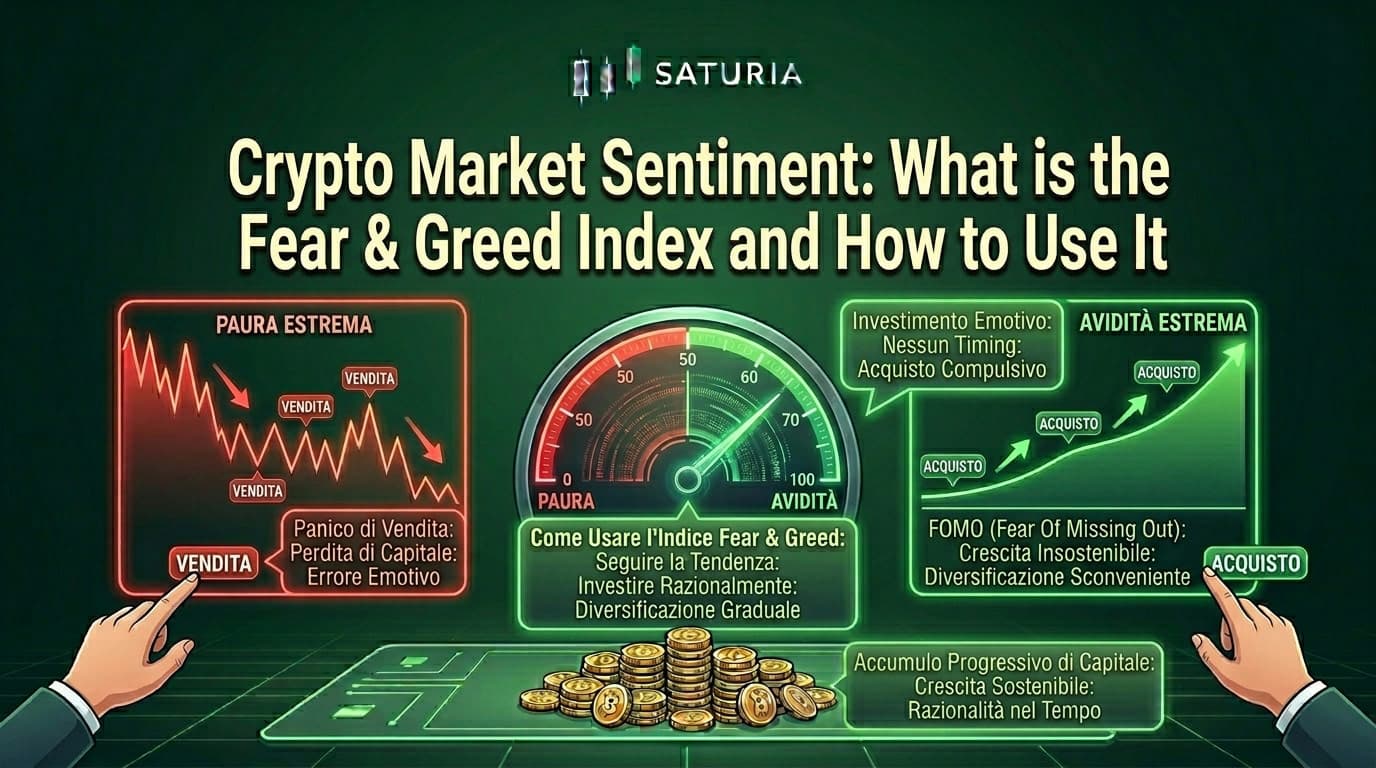
The Fear & Greed Index is an indicator developed by CNNMoney (adapted for the crypto market by Alternative.me) that measures market sentiment on a scale from 0 to 100:
- 0-24: Extreme Fear
- 25-44: Fear
- 45-55: Neutral
- 56-75: Greed
- 76-100: Extreme Greed
The index is updated daily and represents a weighted average of 7 key crypto market factors.
The 7 Factors Comprising the Fear & Greed Index
The index is not arbitrary, but based on 7 specific market components:
- Volatility (25% weight): Measures price variance relative to historical average. High volatility generally signals fear.
- Momentum & Volume (25% weight): Analyzes strength of price movements and trading volume. Positive momentum with high volume indicates greed.
- Social Media (15% weight): Tracks sentiment on social media and frequency of "Bitcoin", "crypto" mentions.
- Market Dominance (10% weight): Measures Bitcoin's percentage of overall market capitalization. Bitcoin dominance = stability; altcoin dominance = speculative frenzy.
- Google Trends (10% weight): Analyzes Google search trends to identify mass interest.
- Pullback from ATH (5% weight): Measures how far prices have retreated from all-time highs.
- Altcoin Performance (10% weight): Evaluates how altcoins are performing relative to Bitcoin.
How the Fear & Greed Index is Calculated
The calculation follows a scientific methodology:
- Each factor is normalized on a 0-100 scale
- Factors are weighted according to established weights (shown above)
- The weighted average produces the final index value (0-100)
- Data is updated daily for fresh information
Practical example: If volatility is high (fear signal) but momentum is positive (greed signal), the index reflects both signals in appropriate proportion.
You can check the live index by visiting sites like Alternative.me where it's updated in real-time.
How to Use the Fear & Greed Index in Your Trading Strategies
1. Identify Buying Opportunities
When the Fear & Greed Index is in Extreme Fear (0-24), the market is heavily sold:
- Investors are panicking and selling without reason
- Prices may have fallen well below intrinsic value
- Ideal time to position in solid fundamental assets
This is the classic contrarian investing signal: buy when others are afraid.
2. Identify Warning Signals
When the index reaches Extreme Greed (76-100):
- Market is driven by speculation and FOMO
- Investors are crowding into hyped altcoins
- Period of maximum risk, where mistakes are easy
- Many experienced traders start taking profits
In these periods, it's prudent to reduce leverage, protect profits with stop loss and diversify.
3. Strategic Dollar Cost Averaging
If you practice Dollar Cost Averaging (DCA), you can modulate your investments based on sentiment:
- Extreme Fear: Increase scheduled investments (market is undervalued)
- Neutral: Maintain your standard DCA plan
- Extreme Greed: Reduce or temporarily suspend (await correction)
4. Contrarian Trading
A classic contrarian strategy is based on the Fear & Greed Index:
- When the index is in extreme fear, contrarian traders buy aggressively
- When it's in extreme greed, they sell and take profits
This strategy works because the market tends to overcompensate during periods of extreme emotion.
Indicator Limitations: What You Need to Know
Like all indicators, the Fear & Greed Index has limitations:
- Doesn't predict prices: The index measures current sentiment, not what happens tomorrow. A market in "extreme fear" could fall further.
- Self-fulfilling prophecy: If many traders use the index the same way, the market might follow collective behavior rather than fundamentals.
- Data lag: The index updates daily, but the crypto market is 24/7. Things can change rapidly.
- Doesn't distinguish fundamentals: A market in fear might be fearful for good reason (exchange hack, negative regulation). The index doesn't account for this.
Important lesson: Use the Fear & Greed Index as one tool among many, not as the only basis for your decisions. Combine it with technical analysis, risk management and project fundamentals.
Sentiment and Trading Psychology
Understanding sentiment also helps you manage your emotions. Many beginners fall into these traps:
- FOMO (Fear of Missing Out): You buy when everyone buys (extreme greed) and miss the tops
- Panic Selling: You sell everything when market crashes (extreme fear) and miss the bottoms
- Herd Mentality: You follow what the masses do instead of thinking critically
The Fear & Greed Index offers you perspective: when you feel a strong emotion, check the index. If your instinct matches the extreme index, take a pause and reflect.
Advanced Strategies With the Index
Combine With Other Metrics
For more robust decisions, combine the Fear & Greed Index with:
- Reading candle charts: Analyze formations in context of sentiment
- Volume: Extreme fear with low volume might be a false signal
- On-chain metrics: What are long-term investors doing (whale tracking)?
Advanced Monitoring
With Saturia, you can set personalized alerts based on market sentiment. For example:
- Receive notification when Fear & Greed drops below 20 (buying opportunity)
- Monitor sentiment for your specific assets via integrated alert system
- Combine global sentiment with your portfolio performance
Empirical Studies and Data
Several studies have shown that the Fear & Greed Index correlates with future returns:
- Extreme fear periods have historically preceded strong rallies in the following 3-6 months
- Extreme greed periods have often preceded corrections or consolidations
- Average sentiment (45-55) tends to produce balanced markets with lower volatility
However, no indicator is perfect. Context (news, regulation, macroeconomics) always matters.
Conclusion: Use Sentiment Wisely
The Fear & Greed Index is a powerful tool for understanding collective market emotionality in crypto. It's not a crystal ball, but a reliable compass:
- Extreme Fear = Potential opportunity (with due diligence)
- Extreme Greed = Caution signal (protect profits)
- Neutral = Balanced market
Your strategy should incorporate market sentiment, but shouldn't depend solely on it. Always combine the Fear & Greed Index with:
- Fundamental analysis of projects
- Rigorous risk management
- Smart diversification
- Personal emotional discipline
With Saturia, you can monitor the Fear & Greed Index alongside your asset performance, receive strategic alerts, and make informed trading decisions. Our dashboard integrates sentiment data to help you navigate the market with greater confidence.
Start using market sentiment in your trading strategies with Saturia - your command center platform for conscious crypto trading.