How to Read Candlestick Charts: A Practical Guide for Beginners
Introduction
If you've ever looked at a Bitcoin price chart on CoinMarketCap or any trading platform, you've seen those strange red and green shapes that look like candles. Everyone talks about "candlestick patterns" and "bullish signals," but if you can't read candlesticks, it all just sounds like random noise.
It's not random. Candlestick charts are one of the most powerful and useful technical analysis tools in trading. Each candle tells a story about the battle between buyers and sellers over a specific period of time.
This article will teach you everything you need to get started. You won't be an expert candlestick pattern reader after this, but you'll understand the basic language the market is speaking.
What Are Candlestick Charts?
A candlestick chart is a way to visualize the price of an asset over a given period of time. Each "candle" represents a time interval—it could be 1 minute, 5 minutes, 1 hour, 1 day, 1 week, etc.
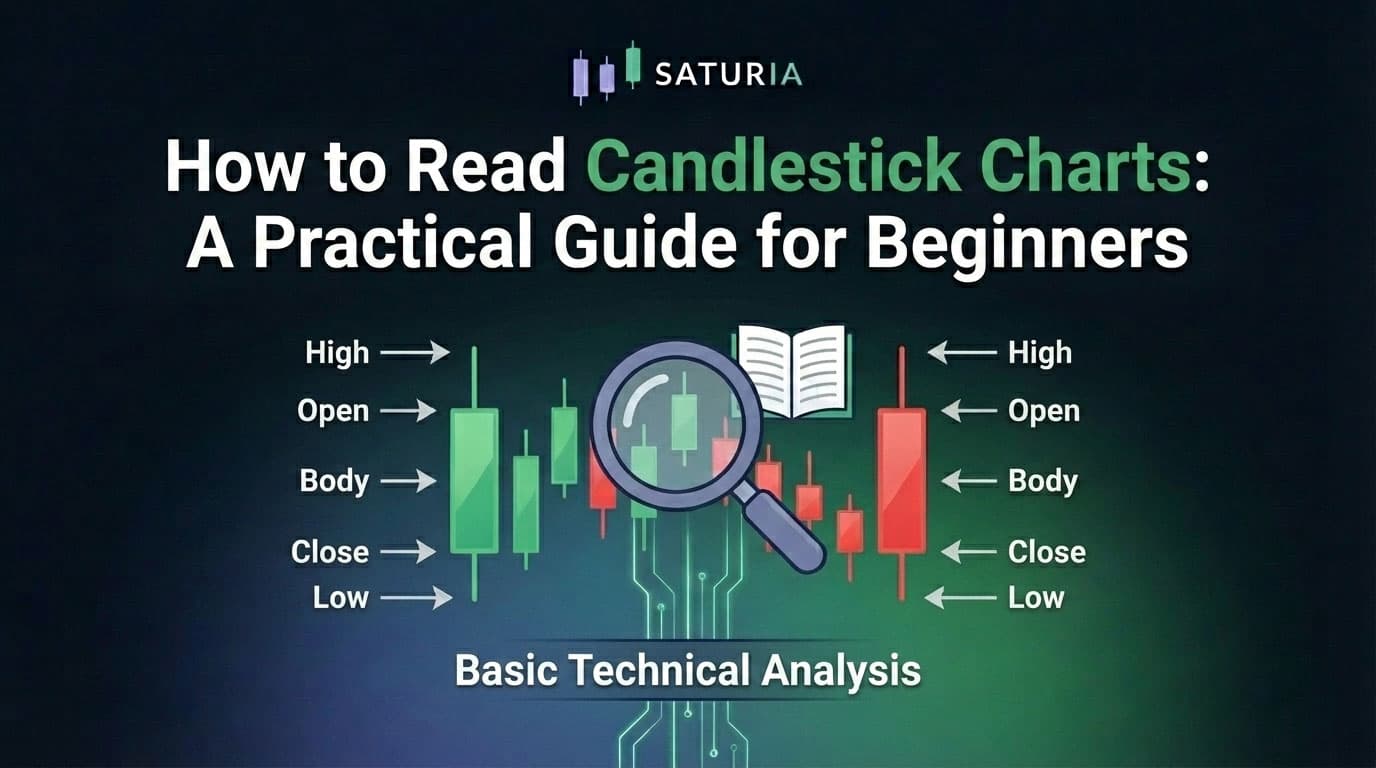
Each candle shows:
- Opening price: the price at which the period started
- Highest price: the highest price reached during the period
- Lowest price: the lowest price reached during the period
- Closing price: the price at which the period ended
Why Candles Instead of Regular Charts?
Candlestick charts contain more information in less space compared to simple line charts. At a glance, you can understand the "story" of a time period: how it started, how high it went, how low it fell, and how it ended.
Line charts only show the closing price, which isn't enough information.
Anatomy of a Candle
Let's analyze a candle in detail. A candle has three main components:
1. The Body
The body is the larger rectangle of the candle. It represents the range between the opening price and the closing price.
- Red/bearish candle: the opening price was higher than the closing price (the price went down)
- Green/bullish candle: the opening price was lower than the closing price (the price went up)
The size of the body tells you how much the price moved during the period.
2. The Upper Wick
The upper wick is a thin line that extends from the top of the body to the highest price.
It represents: "The price rose to this level, but sellers took control and pushed it back down."
A long upper wick suggests that buyers tried to push the price up, but the momentum wasn't strong enough.
3. The Lower Wick
The lower wick is a thin line that extends from the bottom of the body to the lowest price.
It represents: "The price fell to this level, but buyers took control and pushed it back up."
A long lower wick suggests strong demand at lower price levels.
Practical Example
Imagine a green candle with:
- Opening: 42,000
- High: 43,000 (upper wick of 1,000)
- Low: 41,500 (lower wick of 500)
- Close: 42,800
The story is: "Bitcoin opened at 42,000. Buyers tried to push it to 43,000, but sellers resisted and brought it back to 42,800. There was a brief attempt to go down to 41,500, but buyers supported the price."
This is a relatively bullish candle because the body is large and the price closed near the top.
Timeframes: Reading at Different Scales
A crucial concept in trading is the timeframe. The same pair might look like it's in an uptrend on a weekly chart but in a downtrend on a 1-hour chart.
Common Timeframes
- 1 minute, 5 minutes, 15 minutes: Very short-term trading, very noisy, not recommended for beginners
- 1 hour, 4 hours: Intraday trading, good for active traders
- 1 day: Medium timeframe, good for positions lasting days or weeks
- 1 week, 1 month: Long timeframe, good for macro analysis and positions lasting months/years
One Important Rule
If you're reading your trades or making trading decisions, look at the longer timeframe. If you're a 1-day trader, look at at least the 1-day chart. If you're a long-term buyer, look at the weekly chart.
Short-term noise (1 hour, 4 hours) often distracts you and leads to wrong trades when, from the bigger picture, the trend is clear.
Candlestick Patterns: The Basics
A candlestick pattern is a configuration of one or more candles that repeats in the market and statistically precedes a specific price movement.
Not all candlestick patterns have the same reliability, but the main ones are fairly consistent.
Bullish Patterns
#### 1. Doji
Shape: A candle with a very small body and upper and lower wicks of similar sizes. It looks like a cross: +
What it means: Buyers and sellers are in balance. Neither side has control. It often precedes a significant move in one direction or another.
Where it forms: Often at support (where buyers take control) or at the peak of a downtrend (where sellers are exhausted).
How to read it: A Doji isn't bullish or bearish by itself. It's a signal of indecision. Look at the next candle to confirm the direction.
#### 2. Hammer
Shape: A green candle with a small body at the top and a very long lower wick.
What it means: The price fell significantly during the period (long lower wick), but buyers reacted and pushed it back up (green body). Sellers attempted downward pressure but failed.
Where it forms: Often at the bottom of a downtrend, signaling a possible bounce.
How to read it: The Hammer suggests the bottom might have been found. The next candle should confirm with another green candle to validate the signal.
#### 3. Bullish Engulfing
Shape: A small red candle followed by a large green candle that completely "swallows" the previous candle. The body of the green candle covers the body of the red candle.
What it means: Buyers have regained control. Even though the previous period was bearish, in this period buyers pushed the price so high that it completely covered the previous period.
Where it forms: Often at the bottom of a downtrend, signaling a change in momentum toward the upside.
How to read it: Bullish Engulfing is a moderately strong signal of a possible trend reversal to the upside.
#### 4. Morning Star
Shape: Three candles - a large red one, a small one (which could be either red or green), and a large green one. The small "middle" candle is isolated from the bodies of the other two, usually with a gap.
What it means: After strong downward pressure (large red candle), there's uncertainty (small candle), followed by a strong upside recovery (large green candle). It's like the sun rising after a dark night.
Where it forms: At the bottom of a downtrend.
How to read it: The Morning Star is a moderately strong bullish reversal pattern.
Bearish Patterns
#### 1. Shooting Star
Shape: The opposite of a Hammer. A red candle with a small body at the bottom and a very long upper wick.
What it means: Buyers tried to push the price up (long upper wick), but sellers reacted and pushed it back down (red body). Buyers failed to sustain the upside.
Where it forms: Often at the top of an uptrend, signaling a possible pullback downward.
How to read it: The Shooting Star suggests caution if you're long. It could signal weakening bullish momentum.
#### 2. Bearish Engulfing
Shape: A small green candle followed by a large red candle that completely "swallows" the previous candle.
What it means: After a bullish period, sellers have regained control with force.
Where it forms: Often at the top of an uptrend.
How to read it: Bearish Engulfing suggests a possible trend reversal downward.
#### 3. Evening Star
Shape: Three candles - a large green one, a small one, and a large red one. The opposite of the Morning Star.
What it means: After strong upward pressure, uncertainty, followed by strong downward pressure.
Where it forms: At the top of an uptrend.
How to read it: The Evening Star is a moderately strong bearish reversal pattern.
Reading Patterns: Important Rules
1. Confirmation Is Essential
Don't make a trade based on a candlestick pattern without confirmation from the next candle.
For example, if you see a Hammer but the next candle is another large red candle, the pattern is invalidated. The Hammer needed an upside move to confirm.
2. Trend Context
A pattern has different meaning depending on context.
A Doji at the top of a strong uptrend is more significant than a Doji in the middle of a sideways phase.
Always ask: Where are we in the trend? Are we at the top? At the bottom? In the middle?
3. Timeframe Matters
A pattern on a 1-minute chart doesn't have the same importance as a pattern on a 1-day chart.
Patterns on longer timeframes are generally more reliable.
4. It's Not Magic
Candlestick patterns aren't predictions of the future. They're statistically probable, but not certain. Even the best candlestick pattern fails about 30-40% of the time.
For this reason, they must always be combined with:
- Stop-loss and take-profit
- Risk management
- Technical support and resistance levels
- Additional indicators
Support and Resistance: The Context for Patterns
What Are They?
A support is a price level where historically buyers have stepped in and stopped the decline.
A resistance is a price level where historically sellers have stepped in and stopped the rally.
Importance in Reading Candles
A Hammer at support is much more significant than a Hammer in the middle of nowhere.
When you see a candlestick pattern, first ask yourself:
- Is this pattern forming near a support level?
- Is it testing a previous resistance?
- Are we in a supply/demand zone according to broader technical analysis?
If the pattern is aligned with these factors, the probability of success increases significantly.
Active Practice: How to Learn
Phase 1: Passive Study
For the first week, don't trade. Simply:
- Open Saturia or another charting platform
- Watch Bitcoin's daily charts
- Identify patterns you recognize
- Take notes on where you think the price will go
- Wait until the next day and check if you were right
Phase 2: Paper Trading
Once you recognize patterns with some consistency, move to paper trading:
- Open trades based on candlestick patterns you recognize
- Set stop-loss and take-profit based on support and resistance
- Keep a journal of every trade
- Analyze what worked and what didn't
Phase 3: Real Trading
Only after you've had a decent number of winning trades in paper trading (at least 20-30), move to real trades with very small amounts.
Common Mistakes in Reading Candles
1. Looking for Patterns That Aren't There
This is "confirmation bias." You see a pattern because you want to see it, not because it's really there.
Solution: Learn patterns precisely. A Hammer isn't "some kind of thin shape with a lower wick." It's a specific shape with specific proportions.
2. Ignoring the Bigger Picture
Reading a 1-hour pattern without looking at the 4-hour or daily chart is like looking at a square millimeter of a map without the context of the region.
Solution: Always start from the longest timeframe and work your way down.
3. Trading Too Often on Patterns
You shouldn't trade every pattern you see. Many patterns are false signals.
Solution: Filter for patterns that are:
- On longer timeframes
- Near important support/resistance levels
- With good geometry/proportion
- Aligned with the broader trend
4. Not Using Stop-Loss
Even the best candlestick pattern fails sometimes. If you don't have a stop-loss, a controlled loss becomes a catastrophic loss.
Solution: Never trade without a stop-loss. Period.
Tools on Saturia for Reading Candles
Saturia integrates the tools you need to read candles like a professional:
Interactive Charts
Well-drawn candles that are easy to read. You can zoom in on different timeframes effortlessly.
Drawing Tools
Draw support and resistance lines directly on the chart to identify important zones.
Pattern Recognition
Common patterns are highlighted automatically, helping you not miss them.
Annotations
Add notes to specific candles to document your analysis process.
Conclusion: From Chaos to Language
When you first saw a candlestick chart, it probably seemed chaotic: so many lines, so many colors, no sense.
Now you understand that the "chaos" is actually a language. Each candle tells a story of a battle between buyers and sellers. Candlestick patterns are common phrases in that language.
You won't be fluent in "market language" after one article. You'll need:
- Active practice
- Paper trading to test your interpretations
- Maintaining a journal
- Constant review of your analysis
But now you know the basics. You can recognize a Hammer, a Doji, an Engulfing. You can read the body and wicks. You understand timeframes.
That's enough to get started.
On Saturia, open the interactive charts, start identifying patterns, and practice with your virtual portfolio. Mastery comes from practice, not from reading articles.
Good analysis, and remember: the market is always available to teach you if you have the patience to learn.