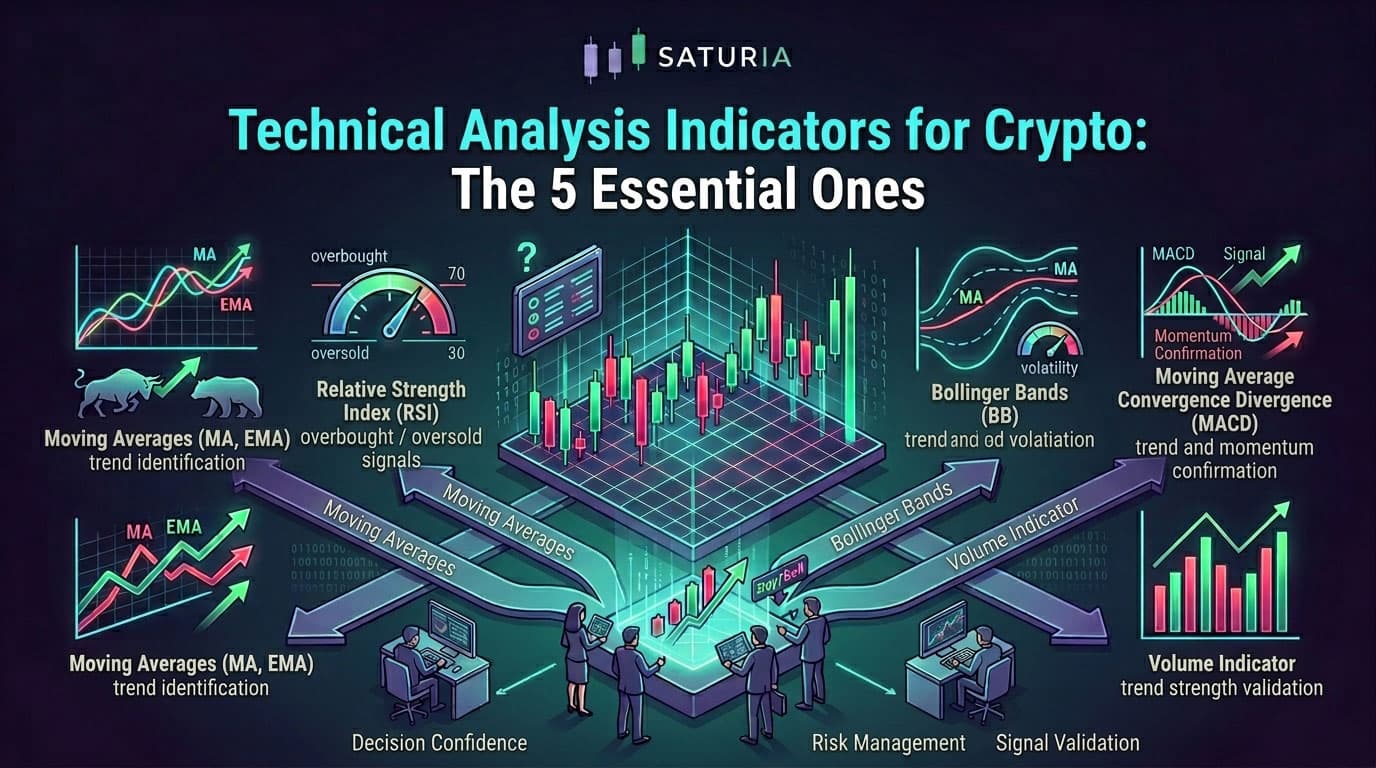
Technical Analysis for Crypto: The 5 Essential Indicators Every Trader Must Know
Technical analysis is the language of trading. If learning to read candlestick charts is step one, then mastering technical indicators is step two. In 2026, indicators remain one of the most reliable tools for identifying entry and exit signals in the crypto market.
But which indicator should you use? With dozens of options available, many beginners feel overwhelmed. In this guide, you'll discover the 5 essential indicators that form the foundation of almost every successful trading strategy.
What is a Technical Indicator?
A technical indicator is a mathematical formula that analyzes historical price and volume data to identify trends, momentum, and potential reversal points in the market.
Indicators fall into two main categories:
Trend Indicators: help identify the direction of price movement (up, down, sideways)
Momentum Indicators: measure the strength of movement and identify when an asset is overbought or oversold
Most successful trading strategies combine at least one trend indicator with one momentum indicator for a more complete market view.
1. RSI (Relative Strength Index)
What is RSI?
The RSI is one of my favorite indicators because it's simple to understand yet incredibly effective. Developed by J. Welles Wilder in 1978, the RSI measures the speed and magnitude of price changes on a scale from 0 to 100.
How it Works
The RSI compares the average of recent gains with the average of recent losses over a defined period (usually 14 periods). The formula is:
`` RSI = 100 - (100 / (1 + (Average Gain / Average Loss))) ``
Interpretation
- RSI < 30: Asset is oversold - potential buy signal
- RSI between 30-70: Neutral zone - balanced market
- RSI > 70: Asset is overbought - potential sell signal
Practical Example: Bitcoin in 2025
Imagine you're monitoring Bitcoin on the 4-hour chart. You notice that BTC has risen rapidly over the past few days and the RSI has reached 78. This indicates that Bitcoin might be overbought. Many traders will interpret this as a sell signal and start taking profits, potentially causing a correction.
Conversely, if the RSI drops to 22, Bitcoin is oversold. Buyers might see this as a buying opportunity before a bounce.
Pros and Cons
Advantages:
- Simple to interpret
- Effective in strong trending markets
- Great for identifying divergences
Disadvantages:
- Can remain in overbought/oversold zones for long periods in strong trends
- Works less well in sideways markets
2. MACD (Moving Average Convergence Divergence)
What is MACD?
MACD is a momentum indicator that shows the relationship between two moving averages of an asset's price. It's excellent for identifying changes in momentum and potential trend reversals.
How it Works
MACD is made up of three elements:
- MACD Line: the difference between the 12-period moving average and the 26-period moving average
- Signal Line: the 9-period exponential moving average of the MACD Line
- MACD Histogram: the difference between the MACD Line and the Signal Line
Interpretation
The main signals are:
- Bullish crossover: when the MACD Line crosses above the Signal Line (buy signal)
- Bearish crossover: when the MACD Line crosses below the Signal Line (sell signal)
- Zero line crossover: when the MACD Line crosses the zero line, it indicates a change in momentum direction
Practical Example: Ethereum
You're monitoring Ethereum on a daily chart. The MACD Line crosses above the Signal Line and the histogram becomes positive. This is a bullish signal - momentum is increasing and we might see an upward push in the coming days.
If the MACD Line subsequently crosses below the Signal Line, this would be the signal to reduce exposure or exit the position completely.
Pros and Cons
Advantages:
- Excellent for identifying momentum changes
- Provides clear and easy-to-follow signals
- Useful in trending markets
Disadvantages:
- Can generate false signals in sideways markets
- It's a "lagging" indicator (follows price, doesn't anticipate it)
3. Moving Averages
What is a Moving Average?
A moving average is the average price of an asset calculated over a specific period. It's one of the simplest but most useful indicators in trading.
Types of Moving Averages
SMA (Simple Moving Average): arithmetic average of closing prices over a period
EMA (Exponential Moving Average): an average that gives more weight to recent prices
In crypto trading, the EMA is often preferred because it responds faster to price changes.
Common Configurations
- EMA 20: Short-term trend (days)
- EMA 50: Medium-term trend (weeks)
- EMA 200: Long-term trend (months)
How to Use Them
Identifying the Trend:
- Price above EMA 200: long-term uptrend
- Price below EMA 200: long-term downtrend
Support and Resistance:
- Moving averages often act as dynamic support/resistance levels
- A price bouncing off the EMA 50 is a signal of trend continuation
Moving Average Crossover:
- When EMA 20 crosses above EMA 50: bullish signal (golden cross in traditional trading)
- When EMA 20 crosses below EMA 50: bearish signal (death cross)
Practical Example: Swing Trading an Altcoin
You're looking to enter a long position on a small altcoin. The price has just bounced off the EMA 50, the price is above the EMA 200, and the EMA 20 is above the EMA 50. All trend indicators are aligned bullishly. This is an excellent setup for entering a buy order.
Pros and Cons
Advantages:
- Simple and effective
- Provide dynamic support/resistance
- Useful on any timeframe
Disadvantages:
- Lagging indicator (reacts after movement has started)
- Less effective in sideways markets
4. Bollinger Bands
What are Bollinger Bands?
Bollinger Bands are a volatility indicator developed by John Bollinger. They consist of three lines: a moving average in the center with two bands (upper and lower) that represent the standard deviation of the price.
How it Works
The bands are constructed as follows:
- Middle Band: 20-period SMA
- Upper Band: 20-period SMA + (2 x standard deviation)
- Lower Band: 20-period SMA - (2 x standard deviation)
The width of the bands increases when volatility increases and decreases when volatility drops.
Interpretation
- Price touches lower band: Asset might be oversold (potential buy)
- Price touches upper band: Asset might be overbought (potential sell)
- Tight bands: Low volatility - often precedes a big move
- Wide bands: High volatility - market is very active
Squeeze and Breakout
One of the most reliable signals is the "squeeze" - when the bands narrow significantly. This indicates that a big move is imminent. The breakout will be in the direction of the previous momentum.
Practical Example: Identifying Low Volatility Before a Pump
You're watching an altcoin's chart and notice that the Bollinger Bands are extremely tight - volatility is very low. This is often a signal that a big move is coming. If the price is above the 20-period SMA and you have other positive indicators (RSI not overbought, MACD positive), it might be time to enter a long position in anticipation of the breakout.
Pros and Cons
Advantages:
- Excellent for identifying volatility and squeeze
- Provides dynamic support/resistance levels
- Useful for managing risk
Disadvantages:
- Not a standalone trading system
- Requires confirmation from other indicators
5. Volume
Why Does Volume Matter?
Volume is often overlooked by beginners, but it's one of the most important indicators in trading. Volume measures how many assets have been traded in a specific period.
The fundamental concept: A price movement supported by high volume is much more reliable than one supported by low volume.
How to Interpret Volume
High Volume + Price Increases: Strong bullish signal. Many traders are actively buying.
High Volume + Price Decreases: Strong bearish signal. Many traders are actively selling.
Low Volume + Price Movement: Potential false breakout. Few traders are participating in the movement - it could reverse quickly.
Declining Volume During a Trend: The trend might be exhausting. If price rises but volume declines, the uptrend might end soon.
Volume Divergence
A "volume divergence" occurs when price continues to rise/fall but volume declines. This is a warning that the trend is losing strength and might reverse.
Practical Example: Confirming a Breakout
Bitcoin is trying to break above a resistance level at $45,000. If it manages to break with high volume, this is a very strong bullish signal that the downtrend is over. But if the breakout happens on low volume, it might be a false breakout and the price could quickly retrace.
Pros and Cons
Advantages:
- Confirms the reliability of other signals
- Simple to interpret
- Available on all charts
Disadvantages:
- Less useful in illiquid markets
- Can be manipulated on exchanges with poor liquidity
Combining Indicators: Creating a Trading Setup
Now that you know the 5 essential indicators, the real power comes from combining them to create a solid setup. Here's an example:
Confirmed Bullish Setup
- Trend (Moving Averages): Price > EMA 50 > EMA 200
- Momentum (RSI): RSI between 40-60 (not overbought)
- MACD: MACD Line above Signal Line
- Volatility (Bollinger Bands): Price hasn't touched the upper band
- Volume: Volume increases during upward moves
If ALL these criteria are met, you have a very reliable bullish setup.
Ideal Platforms for Technical Analysis
Saturia integrates a complete suite of technical indicators derived from TradingView, one of the world's most reliable analysis platforms. With Saturia you can:
- Apply any of the indicators described above to your charts
- Combine multiple indicators to confirm your signals
- Receive alerts when certain indicator criteria are met
- Analyze volume and volatility in real-time
The integration with TradingView means you can access the most powerful analysis tools without having to switch between multiple platforms.
Avoiding Common Indicator Traps
Indicator Mania
The biggest mistake beginners make is adding too many indicators to their chart. It's not true that "more indicators = better signals". In fact, more indicators lead to:
- Conflicting signals and confusion
- Analysis paralysis (inability to make decisions)
- Falling behind the market
I recommend starting with 2-3 indicators maximum until you become proficient.
Ignoring Market Context
Indicators work better in certain market contexts:
- RSI and Bollinger Bands work better in sideways markets (range-bound)
- Moving Averages and MACD work better in trending markets
If the market is sideways and you only use moving averages, you'll receive many false signals. So always understand the market context.
Poor Risk Management
Even with perfect indicators, if you don't implement solid stop loss, you'll lose money. Indicators are aids, not complete trading systems. They must be combined with rigorous risk management.
Next Steps in Your Technical Education
Now that you know the fundamentals, it's time to:
- Practice with Paper Trading: try these indicators without risking real money. Learn more about paper trading
- Learn Risk Management: understand how to use stop loss and take profit to protect your capital
- Develop a Strategy: create a repeatable system based on these indicators
- Test and Iterate: monitor your performance and continuously improve
Conclusion
Technical analysis isn't magic, but it is a science. The 5 indicators we've covered - RSI, MACD, Moving Averages, Bollinger Bands, and Volume - form the foundation of almost every successful trading strategy in the crypto market.
The key is not to use them in isolation. Combine them, confirm them with each other, and always apply them with rigorous risk management and emotional discipline.
If you want to take your technical analysis to the next level, Saturia offers intuitive interfaces with access to all these indicators integrated with TradingView. Start with the free Starter plan and experiment with these indicators in real-time on your crypto portfolio.