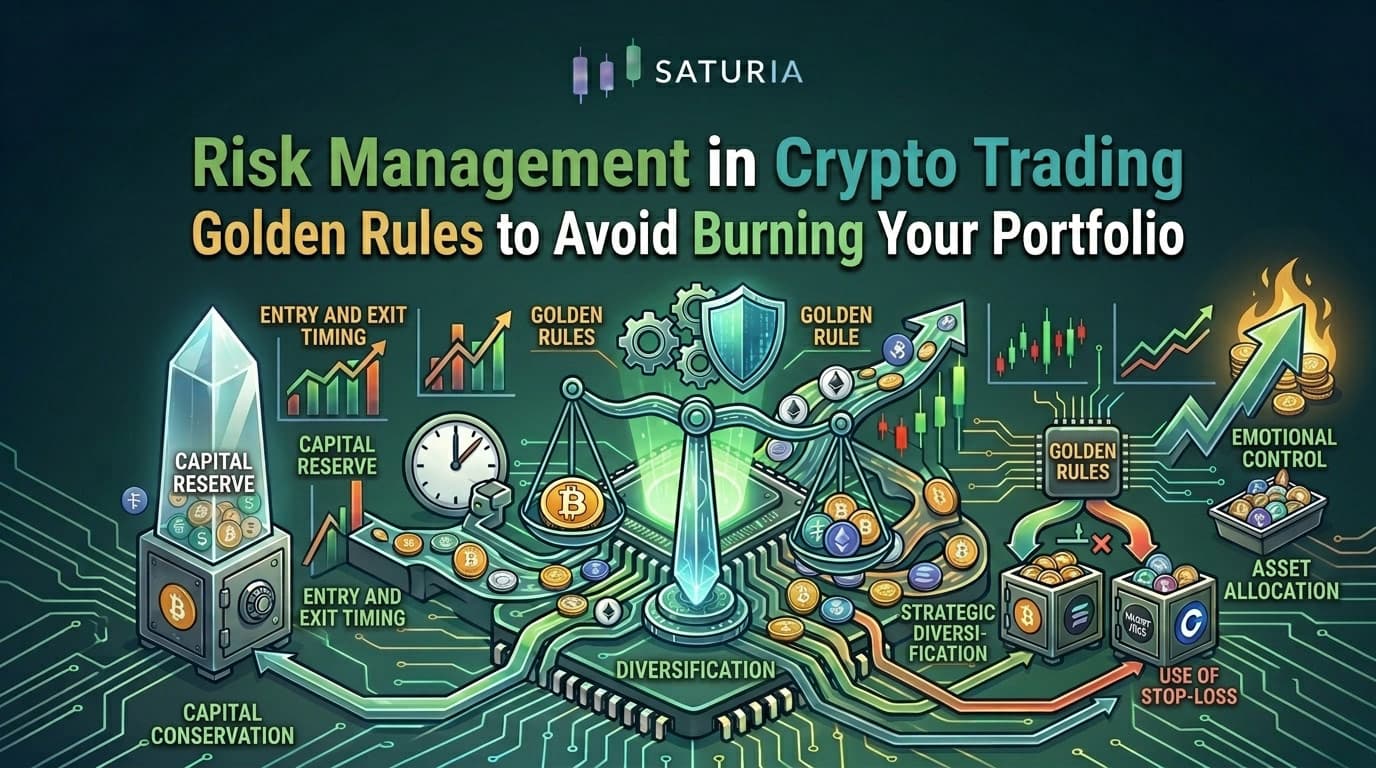
Risk Management in Crypto Trading: Golden Rules to Avoid Burning Your Portfolio
Introduction
Warren Buffett, one of the world's richest investors, said something every crypto trader should tattoo on their brain:
> "Rule number one of investing is not to lose money. Rule number two is not to forget rule number one."
Yet, for some reason, crypto trading seems to attract people who completely ignore this wisdom. We constantly see stories of traders losing 50%, 80%, even 100% of their capital in weeks.
What's the common denominator? Poor risk management.
Risk management isn't sexy. It doesn't generate viral success stories on Twitter. It's not what you hear in hype on forums. But it's the difference between traders who build wealth over time and those who burn through capital.
This article will teach you the fundamental risk management rules that can literally save you from financial ruin.
What is Risk Management?
Risk management in trading is the process of identifying, measuring, and controlling your exposure to risk in individual trades and your portfolio as a whole.
It's not just about not losing money. It's about:
- Defining how much money you're willing to lose before starting a trade
- Calculating the correct position size based on your risk
- Protecting your portfolio from catastrophic losses
- Maintaining emotional discipline when trades go wrong
Risk management is the foundation on which any sustainable trading strategy is built.
The Golden Rule: The 1-2% Principle
What is it?
The 1-2% rule is perhaps the most important concept in risk management. Here's how it works:
Never risk more than 1-2% of your total capital on a single trade.
If your trading account is €10,000, the maximum you should risk on one trade is €100-200. If your account is €100,000, the maximum is €1,000-2,000.
Why It Works?
To understand the power of this rule, consider an example:
Scenario A: No Risk Management
- Starting account: €10,000
- Win rate: 50% (half of trades win)
- Risk per trade: 30% of account (€3,000)
Here's what happens:
- Trade 1: LOSS -€3,000 → Account = €7,000
- Trade 2: LOSS -€2,100 (30% of €7,000) → Account = €4,900
- Trade 3: LOSS -€1,470 → Account = €3,430
- Trade 4: LOSS -€1,029 → Account = €2,401
With a 50% win rate, you've already lost 76% of your capital after just 4 consecutive losing trades (which is completely possible). You're now ruined and out of the game.
Scenario B: 1-2% Rule
- Starting account: €10,000
- Win rate: 50% (half of trades win)
- Risk per trade: 1% of account (€100)
With the same series of 4 consecutive losses:
- Trade 1: LOSS -€100 → Account = €9,900
- Trade 2: LOSS -€99 → Account = €9,801
- Trade 3: LOSS -€98 → Account = €9,703
- Trade 4: LOSS -€97 → Account = €9,606
You've lost less than 4% of your capital. You're still in the game.
This is not a random comparison. It's the difference between guaranteed failure and sustained resilience.
How to Calculate the Correct Position Size
The 1-2% rule is the starting point, but how do we apply it practically?
Basic Formula
`` Position Size = (Maximum Risk) / (Distance to Stop-Loss) ``
Let's do an example:
- Account: €10,000
- Maximum risk per trade: 1% = €100
- You're trading Bitcoin at €42,000
- Your stop-loss is at €41,000
- Distance to stop-loss: €1,000
Position Size = €100 / €1,000 = 0.1 BTC
If Bitcoin drops exactly to your stop-loss, you'll lose exactly 1% of your account.
Tools for Calculation
On Saturia, the position management tools automatically help you to:
- Calculate the correct position size
- Automatically set stop-loss at your desired level
- Monitor the risk/reward of each position
This takes the math out of risk management and makes it a simple, consistent practice.
Diversification: Don't Put All Your Money in One Cryptocurrency
The Principle
Diversification is the other half of risk management. While position sizing controls the risk per single trade, diversification controls the overall portfolio risk.
The traditional wisdom says: "Don't put all your eggs in one basket." In crypto trading, this means:
- Don't put everything in a single coin
- Don't put everything in a single crypto sector (DeFi, L1, meme coins, etc.)
- Don't keep everything in open positions
Diversification for Crypto
A balanced crypto portfolio typically includes:
- Core holdings (50-60%): Bitcoin and Ethereum, the most stable and liquid cryptos
- Quality altcoins (20-30%): Coins with solid fundamentals
- Speculative positions (10-20%): Innovative projects with high risk/high reward
- Stablecoins/Cash (10-20%): For opportunities and volatility reduction
This allocation isn't dogmatic. It could be different based on your risk profile. But the important thing is having a structure.
Many beginners make the mistake of putting 100% of their portfolio in a single altcoin they discovered on Reddit. Inevitably, when that coin drops 70%, they burn 70% of their capital.
With diversification, the same coin's decline impacts only 10-20% of your portfolio.
Temporal Diversification
There's another type of diversification often overlooked: temporal diversification.
Don't enter all positions at the same time. If you use a dollar-cost averaging (DCA) strategy, you spread your purchases over time. This reduces the risk of entering at market peak.
Stop-Loss: Your Parachute
What is a Stop-Loss?
A stop-loss is an order that automatically sells a position when the price drops to a specific level. It's your parachute when a trade goes wrong.
Without a stop-loss, you're relying on:
- Your ability to tolerate psychological pain
- Your discipline when the position is in red
- Hope that the price will rise again
None of these is a reliable strategy.
When Should You Use a Stop-Loss?
The simple answer: always.
On Saturia, you can automatically set a stop-loss when you open a position. It's not optional. It's a rule.
The only exception might be for a very long-term HODL position (years), but even then, many professionals maintain a very wide conservative stop-loss.
Stop-Loss Levels
Your stop-loss shouldn't be random. It should be based on:
- Technical support: a level where the price has historically bounced
- Your risk tolerance: if you're willing to risk 2% of capital, you calculate the level that results in exactly this risk
- Coin volatility: more volatile coins require wider stop-losses
On candlestick charts, you can identify support levels that are good candidates for stop-losses.
Take-Profit: Protect Your Gains
If stop-loss protects you downside, take-profit protects you from yourself.
The Problem of "Wait a Little Longer"
Once a position is in profit, many traders fall for this temptation:
"It's up 20%... but if I wait a bit longer, it could do 50%!"
So they wait. And the price drops. And the 20% profit becomes a -5% loss. And the trade that should have been a win becomes a loss.
Setting Profit Targets
On Saturia, when you open a position, you should set at least one take-profit at the level that represents your target risk/reward ratio.
A 1:2 risk/reward ratio is a common standard:
- If you risk €100 (stop-loss), your take-profit should be at a level where you earn €200
With this ratio, even with a 40% win rate, you're still profitable long-term.
Mental Disciplines: 90% of the Battle
All the technical risk management in the world doesn't matter if you can't control yourself emotionally.
Violating Your Own Rules
The number one enemy of risk management is violating your own rules.
Common examples:
- "I said I wouldn't risk more than 1%... but this trade is special, I'll risk 5%"
- "My stop-loss is at 40,000... but it might bounce, I'll let it run"
- "I take profits at 20%... but this time I'll wait for 50%"
Every time you violate a rule "for a good reason", you're sowing chaos. The next time it will be easier to violate it. And the next time. Until you have no rules.
The Solution: Automation
The best antidote is automating as much as possible. On Saturia:
- Set your stop-losses automatically when you open a position
- Set your take-profits automatically
- Use alerts for important positions
When orders are already placed, you can't change your mind. Discipline is automatic.
Limiting Trades
Another crucial discipline: limiting the number of trades you make. Don't open 20 positions simultaneously if you can't effectively monitor all of them.
Many experienced traders operate with 3-5 open positions maximum. This allows you to maintain full control and discipline over each position.
The Diversification in Risk Rule
Even with the 1-2% rule, you can hurt yourself if you open too many maximum-risk positions simultaneously.
Example:
- Account: €10,000
- 5 open positions, each with 2% risk = 10% total risk
- If all 5 go bad simultaneously, you lose 10%
This is still acceptable. But if you open 10 positions at 2%, the total risk is 20%, which is dangerous.
Suggested Rule
Total portfolio risk: maximum 5-10% per trading cycle.
If you have 5 open positions, each should risk maximum 1-2%. If you have 10, each should risk 0.5-1%.
On Saturia, the portfolio monitoring dashboard shows your total aggregated risk from all positions. It's critical to check it regularly.
Risk Management in Different Market Scenarios
Bull Market
In a bull market, the biggest risk is becoming too aggressive. When everything is rising, it's easy to forget risk management.
Still maintain discipline:
- Don't increase position size beyond your 1-2%
- Don't skip stop-losses
- Don't concentrate your entire portfolio in speculative positions
Bear Market
In a bear market, the biggest risk is panic.
Defensive strategies:
- Increase your stop-losses in line with rising volatility
- Reduce position sizes
- Keep more cash available
- Remember that losses are only temporary if you don't realize them
High Volatility
When volatility rises (usually measured by the fear and greed index):
- Increase your stop-loss distance (coins fluctuate more)
- Reduce position size
- Trade on longer timeframes to reduce noise
- Use smart alerts to stay informed without constantly trading
Saturia Tools for Risk Management
Saturia was designed with risk management in mind. Some key tools:
Automatic Position Sizer
Enter your total capital, risk tolerance, and desired stop-loss level. Saturia automatically calculates the correct position size.
Risk/Reward Visualization
Each position immediately shows:
- How much you're risking
- How much you can potentially earn
- Your risk/reward ratio
Portfolio Risk Dashboard
See your total portfolio risk exposure in real-time. If you reach dangerous limits, you get an alert.
Order Automation
Set stop-loss and take-profit once and forget about emotions. Orders execute automatically.
When Risk Management Fails
Even the best risk management can't protect you from rare catastrophic events:
- Exchange hack
- Technical issues preventing position closure
- Flash crash
- Exchange failure
That's why:
- Don't put all your capital on a single exchange
- Don't keep large amounts on exchanges. Use cold wallet for HODL
- Diversify across exchanges
- Keep a cash reserve outside of trading
Conclusion: Risk Management is Your Invincible Shield
There are thousands of trading strategies in crypto. Some work, others don't. But there's one thing all successful traders have in common: rigorous and disciplined risk management.
Risk management won't make you rich quickly. It's not sexy. It won't generate viral stories about doubling capital in a week.
What it will do is protect you from ruin.
When you practice the 1-2% rule, diversify your portfolio, automatically set stop-loss and take-profit, and maintain emotional discipline, you're building a solid foundation.
With this foundation:
- You can tolerate a series of losing trades without panic
- You can trade for years without burning your capital
- You can actually build wealth over time
On Saturia, all the tools for professional risk management are at your disposal. The question is: will you use them?
Happy trading, and remember: protecting capital is the number one game.