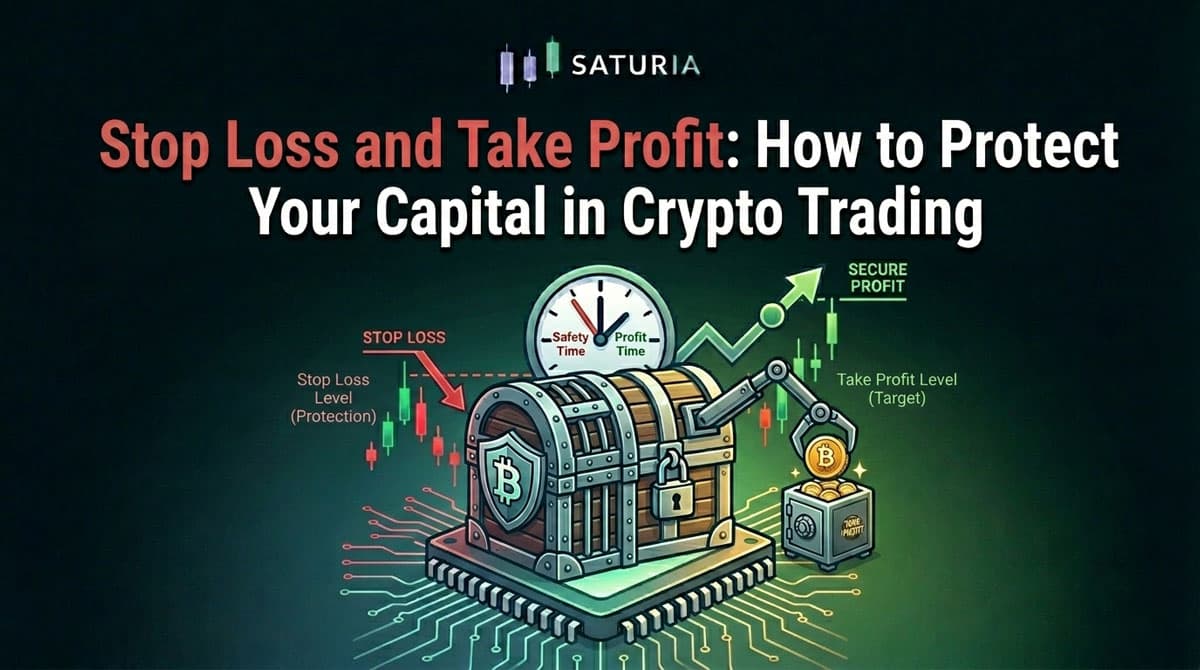
Stop Loss and Take Profit: How to Protect Your Capital in Crypto Trading
There's a saying in trading: "If you don't protect your capital, the market will do it for you - and you won't like it."
This is the essence of stop loss and take profit. While beginners often focus on how to enter a position, professional traders know that the real skill lies in the discipline of EXITING a position at the right time.
In this comprehensive guide, you'll discover not only what stop loss and take profit are, but how to calculate them, set them correctly, and use them as part of a solid risk management strategy.
Why Stop Loss and Take Profit Are Critical
The Emotional Cost of Trading
Imagine this scenario: you've just bought Bitcoin at $40,000. You did good research, the indicators are aligned, everything seems perfect. Then, the next day, the market crashes and Bitcoin drops to $37,000.
What do you do?
Scenario 1 (Without Stop Loss):
- You hope the price bounces back
- You nervously watch the chart
- When it finally bounces to $39,000, you sell to limit damage
- Loss: $1,000 on $40,000 (2.5% loss)
Scenario 2 (With Stop Loss at $38,500):
- Your stop loss triggers automatically at $38,500
- You're not emotional, the order is already executed
- Predetermined loss: $1,500 on $40,000 (3.75% loss)
- But now you're OUT of the market and free to find the next opportunity
I know Scenario 2 lost more money in this example. But here's the point: in Scenario 1, your $39,000 could drop to $35,000 the next day, and the emotional pain could drive you to panic sell at the bottom. In Scenario 2, your loss has already happened, it's defined, and you can move forward.
Mathematical Protection
Capital protection is the most important factor in long-term trading profitability. A trader who makes 5% per trade but has occasional losses of 30% won't be profitable long-term.
According to Investopedia, stop loss is one of the most important risk management techniques in trading any asset.
If you want to survive in crypto, you must accept that some of your positions will lose money. The question isn't "How do I avoid losing trades?" but "How do I control the damage when a trade goes wrong?"
What is a Stop Loss?
Basic Definition
A stop loss (or stop order) is an order that automatically sells an asset if the price drops to a predetermined level. It's a safety net that prevents your losses from becoming catastrophic.
How it Works
- You buy Bitcoin at $45,000
- You set a stop loss at $43,000
- If Bitcoin's price drops to $43,000, your sell order triggers automatically
- You're out of the position, with a maximum loss of $2,000
Without the stop loss, if the price continues dropping to $35,000, your loss could have been $10,000.
The Psychology of Stop Loss
Beyond mathematical protection, a stop loss offers emotional protection. Knowing in advance how much you're willing to lose allows you to sleep at night. You're not constantly stressed and you're not subject to fear-based decisions.
What is Take Profit?
Basic Definition
A take profit is the opposite of a stop loss. It's an order that automatically sells your asset when the price rises to a predetermined profit level.
How it Works
- You buy Ethereum at $2,500
- You set take profit at $2,750 (3% gain)
- If Ethereum's price rises to $2,750, your sell order triggers automatically
- You've captured the profit and are out of the position
Why Beginners Skip Take Profit
Many beginners skip take profit because they have a "HODL" mentality. They think: "Why should I sell if the price could go even higher?"
This mentality is dangerous. Often, the price rises to $2,750, your take profit doesn't exist, and the price crashes to $2,400. You got greedy and lost the profit you had gained.
Take profit captures your winnings. You can always re-enter if the trend continues.
How to Calculate Stop Loss and Take Profit
The Percentage Method (The Simplest)
The simplest method is the percentage method. Choose a maximum percentage you're willing to lose, and a profit target.
Example: Trading Bitcoin
- Entry price: $45,000
- Maximum acceptable risk: 2% (maximum loss of $900)
- Stop loss: $45,000 - ($45,000 × 0.02) = $43,900
- Profit target: 4% (maximum desired profit of $1,800)
- Take profit: $45,000 + ($45,000 × 0.04) = $46,800
The Support/Resistance Method (More Advanced)
More experienced traders use support and resistance levels to set stop loss and take profit.
If you're entering a long position in Ethereum, you might:
- Enter just above an important resistance level
- Set your stop loss BELOW the nearest support level
- Set your take profit at the next important resistance level
This approach uses market structure rather than arbitrary numbers.
The ATR Method (Average True Range)
ATR is a technical indicator that measures the average volatility of an asset over the last N periods. It's useful for adjusting your stop loss and take profit to current volatility.
Simple formula:
- Stop Loss = Entry Price - (ATR 14 × 1.5)
- Take Profit = Entry Price + (ATR 14 × 2)
This approach ensures your stop loss is proportional to market volatility. In a highly volatile market, your stop loss will be wider. In a calm market, it will be tighter.
Strategic Stop Loss Placement
Behind Support/Resistance Levels
Don't set your stop loss exactly at an obvious support level. Place it slightly BELOW the support to avoid being "shaken out" (liquidated by sharp moves that then bounce).
Example:
The obvious support on Bitcoin is at $43,000. Instead of setting your stop loss at $43,000, set it at $42,800. This protects you from the sharp spikes that often precede bounces.
Behind Moving Averages
If your trading is based on moving averages (as described in technical analysis for crypto), you can set your stop loss behind the moving average you're using.
If you're trading with the strategy of price above EMA 50, you might set your stop loss to trigger when price drops BELOW the EMA 50.
Behind Swing Lows/Highs
For traders using candlestick pattern analysis, the stop loss can be set behind recent swing lows/highs (the highest and lowest points of recent movements).
Calculate the Risk/Reward Ratio
What is Risk/Reward Ratio?
The risk/reward ratio is the relationship between how much you risk and how much you can potentially gain.
Example:
- Risk: from $45,000 to $43,000 = $2,000 risk
- Reward: from $45,000 to $48,000 = $3,000 potential profit
- Risk/Reward Ratio: 1:1.5 (you're risking 1 to earn 1.5)
The Golden Rule: Minimum 1:2
The golden rule of trading is to have a risk/reward ratio of at least 1:2. This means for every dollar you risk, you're aiming to earn at least 2 dollars.
Why? Because even the best traders don't win 100% of their trades. If you're correct 50% of the time, with a 1:2 ratio, you're still profitable:
- 50 winning trades × $2 = $100 profit
- 50 losing trades × $1 = -$50 loss
- Net profit: $50
If you instead had a 1:1 ratio with 50% wins:
- 50 winning trades × $1 = $50 profit
- 50 losing trades × $1 = -$50 loss
- Net profit: $0 (break even)
See crypto trading risk management for a more detailed guide.
Trailing Stop: Dynamic Protection
What is a Trailing Stop?
A trailing stop is a moving stop loss. Instead of setting a fixed stop loss, the trailing stop moves upward as the price rises.
How it Works
- You buy Bitcoin at $40,000
- You set a trailing stop of 3%
- If the price rises to $41,000, your stop loss automatically moves to $39,970 ($41,000 × 0.97)
- If the price continues rising to $42,000, the stop loss moves to $40,740
- If the price drops to $40,735, the trailing stop triggers and you sell
When to Use Trailing Stop
The trailing stop is perfect for:
- Strong uptrends: When price is continuously rising, the trailing stop protects your profits while capturing the trend
- Scalping: Used by traders seeking small frequent gains
- Position management: When you want to let the trade "run" but want protection if the trend reverses
Trailing Stop Disadvantage
The main disadvantage is that in highly volatile markets, you might get stopped out by false signals. If the price drops 3% for a normal correction, you're out of the trade only to watch the price rise again.
For this reason, many professional traders use trailing stops only during strong, confirmed trends.
Managing Multiple Positions with Stop Loss and Take Profit
In the real world, you never hold just one position. One of the mistakes beginners make is not knowing how to manage multiple positions simultaneously.
Partial Exit Scaling
Instead of setting a single take profit, many traders exit the position in parts:
Example with a 10 BTC position:
- 3 BTC at take profit +5%
- 3 BTC at take profit +10%
- 2 BTC at take profit +20% (with trailing stop to capture the trend)
- 2 BTC with stop loss at -5% (a small part with more risk for more reward)
This approach captures profits gradually while also allowing part of the position to "run" for big gains.
Common Mistakes to Avoid
Mistake 1: Stop Loss Too Tight
Many beginners set a stop loss less than 1% below their entry. This is too tight. In volatile markets, you could get shaken out by normal moves.
Recommendation: Minimum 2-3% for short-term trading, 5-10% for swing trading, 15%+ for position trading.
Mistake 2: Ignoring Take Profit
Some traders never set a take profit, hoping the price will rise infinitely. In reality, price rises and falls in cycles. Setting a take profit lets you capture profits when the price rises.
Mistake 3: Moving Your Stop Loss
This is perhaps the most costly mistake. You set a stop loss at $43,000, the price drops to $42,500, and you think "I can't take that loss, I'll move it to $42,000".
This causes you to capitulate when the market is testing your support level, which might bounce. It's an emotional decision, not a rational one.
Golden Rule: Once you set your stop loss, you NEVER move it, unless you're moving it in your favor (to protect profits).
Mistake 4: Take Profit Too High
If you set a take profit at +50%, the price might never reach it and you miss the opportunity. Set realistic take profit based on technical levels, not random numbers.
Implementing Stop Loss and Take Profit on Saturia
Saturia makes it extremely easy to set stop loss and take profit for your positions. With Saturia's intuitive interface:
- OCO Orders (One-Cancels-Other): Set a stop loss and take profit simultaneously. If one triggers, the other is automatically cancelled.
- Trailing Stops: Set trailing stops in a few clicks to protect your profits during uptrends
- Alert System: Get notified when your stop loss/take profit levels are near, allowing you to monitor the situation
- Position Management: View all your active positions with their stop loss and take profit levels in one dashboard
Whether you're a beginner setting your first trade or an advanced trader managing a portfolio of 50 positions, Saturia makes the process intuitive and quick.
The Psychology of Risk Management
Beyond the numbers, the real power of stop loss and take profit is psychological.
When you know your maximum risk for a trade is defined, you can:
- Sleep at night
- Avoid panic selling
- Stay disciplined during volatility
- Trade according to your plan, not emotions
Traders who become wealthy in crypto aren't those with the biggest winning trade. They're those who manage their risk better than anyone else.
As a famous trader says: "My first trade is always a cut-off trade. If I exit and take a small loss, I've already won."
This mentality - protecting capital first - is what separates professional traders from amateurs.
Checklist for Your Next Trade
Before entering any position, make sure you go through this checklist:
- Have I established my entry price?
- Have I calculated my maximum acceptable risk (1-5% of portfolio)?
- Have I set a stop loss to protect this loss?
- Have I calculated a realistic profit target (at least 1:2 risk/reward)?
- Have I set a take profit at my target?
- Have I chosen the correct order type (market, limit, OCO)?
- Is my position correctly sized for the risk?
If you can answer "yes" to all these questions, you're ready to enter the trade.
Conclusion
Stop loss and take profit aren't "nice to have" in crypto trading - they're essential. They're the difference between a trader who survives long-term and one who burns out quickly.
In 2026, with crypto market volatility, protecting your capital is more important than ever. Every trade you make should have these orders set in advance, not "after I see how it goes".
Remember: your first job as a trader is not to make money. It's NOT to lose money. Once you protect your capital, profits will follow naturally.
Start today with Saturia, set your stop loss and take profit, and trade with the confidence of a professional.