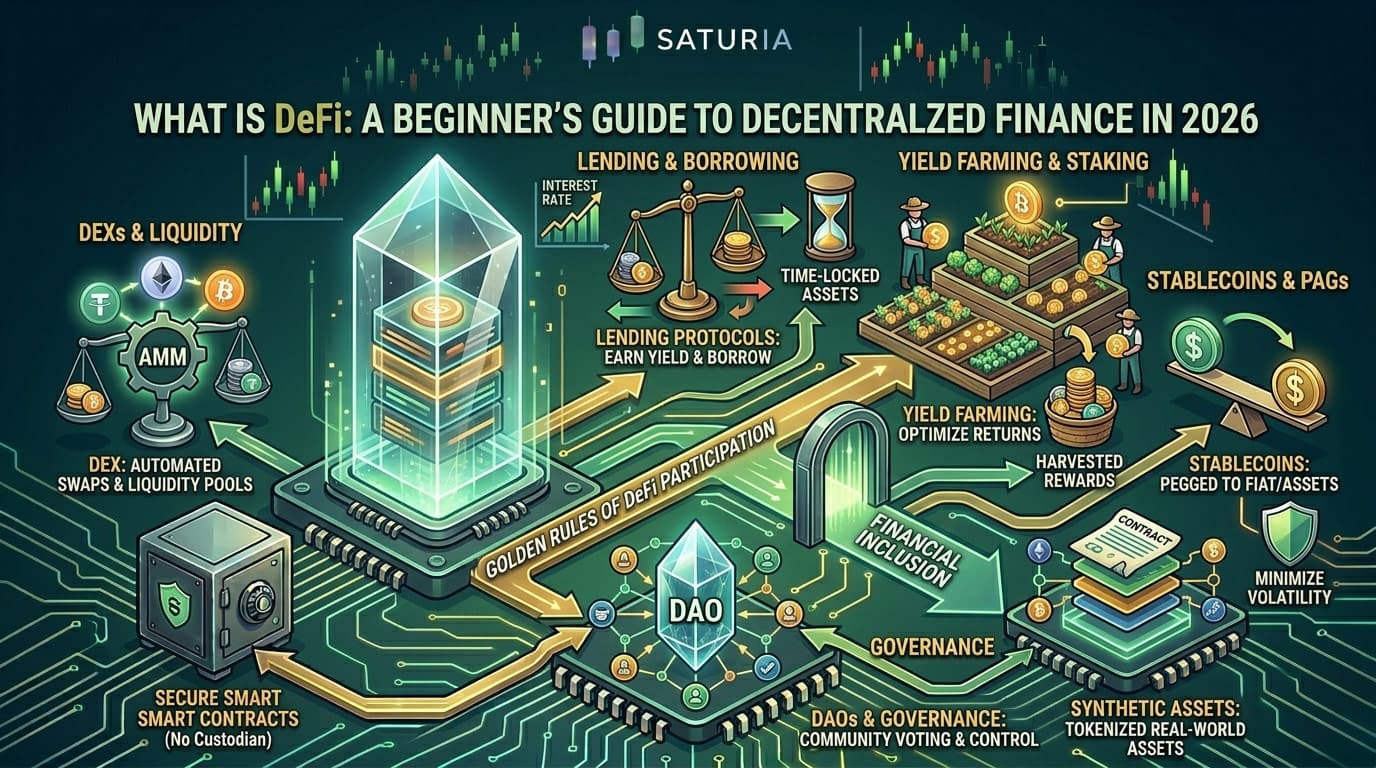
What is DeFi: A Beginner's Guide to Decentralized Finance in 2026
Decentralized finance, commonly known as DeFi, represents one of the most significant revolutions in the world of cryptocurrencies. If you're taking your first steps in crypto trading, understanding the concept of DeFi is essential to leverage the best investment opportunities and generate passive income.
In this comprehensive guide, we'll explore what DeFi is, how it works, the fundamental differences with traditional centralized finance, and how to start operating safely.
What is DeFi: Definition and Core Concepts
DeFi (Decentralized Finance) is an ecosystem of financial applications built on blockchain that eliminates traditional intermediaries like banks and brokers. Instead of relying on central financial institutions, DeFi uses smart contracts to automate transactions and provide financial services directly from user to user.
In other words: in traditional finance, if you want to borrow money, you go to a bank that decides whether to approve you. In DeFi, smart contracts automatically manage the loan based on predefined rules, with no need for human approval.
The Pillars of DeFi
DeFi is built on four fundamental principles:
- Transparency: All transaction data is public and verifiable on the blockchain
- Immutability: Once recorded, a transaction cannot be altered
- Accessibility: Anyone with an internet connection can participate, with no geographic barriers
- Decentralization: No central authority controls the system
DeFi vs CeFi: Key Differences
Understanding the differences between decentralized and centralized finance is fundamental to choosing the investment strategy that best suits your needs.
Centralized Finance (CeFi)
In centralized finance:
- A company or institution manages your funds and transactions
- You must provide identity documents (KYC) to operate
- There's a corporate structure with employees and management costs
- Your account can be frozen by authorities or the platform
- It offers better customer support and deposit insurance
- Examples: Binance, Kraken, traditional exchanges
Decentralized Finance (DeFi)
In decentralized finance:
- Smart contracts automatically manage transactions
- KYC is not required for most services
- There are no intermediaries with high costs
- Only you control your funds through your private wallet
- Security responsibility falls on you
- Examples: Uniswap, Aave, Curve Finance
A useful comparison table:
| Aspect | CeFi | DeFi |
|---|---|---|
| Fund Control | Platform | User (private wallet) |
| Transaction Speed | Slow (days) | Fast (minutes) |
| KYC Required | Yes | No (generally) |
| Costs | High commissions | Variable (gas) |
| Security | Centralized | Code-based |
| Customer Support | Available | Community |
Major DeFi Protocols and the TVL Concept
What is TVL?
TVL (Total Value Locked) represents the total amount of cryptocurrencies locked in the smart contracts of a DeFi protocol. It's one of the most important indicators for assessing the health and adoption of a protocol.
For example, if a protocol has a TVL of 1 billion dollars, it means users have deposited cryptocurrencies worth a total of 1 billion dollars in its smart contracts.
Why is TVL important?
- It indicates the level of user trust in the protocol
- It reflects perceived technical soundness and security
- It influences the liquidity available for transactions
- Growing TVL usually means greater adoption
Major DeFi Protocols in 2026
Uniswap - The Most Important DEX
- Allows direct swapping of ERC-20 tokens
- Mechanism: Automated Market Maker (AMM)
- TVL: over $3 billion
- Suitable for: traders seeking liquidity and low slippage
Aave - Leading Lending Protocol
- Allows you to lend and borrow cryptocurrencies
- Generates interest on deposits and payments on loans
- TVL: among the highest in the DeFi ecosystem
- Suitable for: those wanting to generate passive income
Curve Finance - Stablecoin Specialist
- Optimized for stablecoin swapping with low slippage
- Ideal for traders operating with stable currencies
- Interesting returns for those providing liquidity
Lido - Liquid Staking
- Allows you to stake ETH without locking it
- You receive liquid tokens while earning rewards
- Simplifies the staking process
Learn more about staking and yield farming
How DeFi Works: The Role of Smart Contracts
Smart contracts are the heart of DeFi. They are programs that run on the blockchain and automatically execute their instructions when certain conditions are met.
Practical Example: A Uniswap Swap
- You deposit 1 ETH into the Uniswap liquidity pool
- The smart contract automatically registers your deposit
- You receive LP tokens (Liquidity Provider) as a receipt
- Every time someone swaps tokens in the pool, a small fee is distributed to liquidity providers
- You can withdraw your funds + earned fees anytime
No intermediary, no approval: everything is automatic and transparent.
Opportunities in DeFi in 2026
DeFi offers several earning opportunities:
Cryptocurrency Staking
Lock your tokens and earn rewards. APY (annual return) typically ranges from 3% to 20% depending on the protocol.
Yield Farming
Provide liquidity to swap pools and receive fees + incentive tokens. Potentially higher returns but with greater risks.
Lending
Lend cryptocurrencies to other users through protocols like Aave and receive interest automatically.
Trading
Swap tokens directly on DEXs (Decentralized Exchanges) without depositing funds with an exchange.
DeFi Risks You Need to Know
Before you start, it's critical to understand the risks:
Smart Contract Risk
The code might contain bugs or vulnerabilities allowing malicious actors to steal funds.
Rug Pull
Developers could disappear with user funds after promising impossible returns.
Impermanent Loss
If you provide liquidity and token prices change significantly, you might suffer losses even if the pool remains profitable for others.
Oracle Manipulation
If token prices are determined by centralized oracles, they could be manipulated to benefit certain users.
Read the complete guide on DeFi risks
Monitor the DeFi Market With Saturia
Saturia offers advanced tools to monitor the DeFi ecosystem in real time:
- Crypto Calendar: Monitor important on-chain events, including token unlocks and DeFi protocol changes
- Alert System: Receive notifications when your preferred protocols' TVLs change significantly
- Portfolio Management: Track your DeFi investments in a single professional dashboard
- DeFi Wallet Integration: Directly connect your DeFi wallets for complete monitoring
Next Steps to Get Started With DeFi
- Choose a wallet: Read the DeFi wallet guide
- Learn technical trading: Understand candlestick charts
- Understand risk management: Risk management guide
- Start with small amounts: Try with small figures to learn without risking big losses
- Use Saturia to monitor: Track all your DeFi investments in one unified dashboard
Conclusion
DeFi represents the future of finance, offering unprecedented opportunities to generate passive income and completely control your funds. However, like any innovative technology, it carries significant risks.
The key is to continuously educate yourself, start small, and use tools like Saturia to monitor your investments in real time. With the right knowledge and proper caution, DeFi can become an important part of your crypto trading strategy.
Start exploring the DeFi ecosystem today with Saturia - your all-in-one dashboard for professional crypto trading.