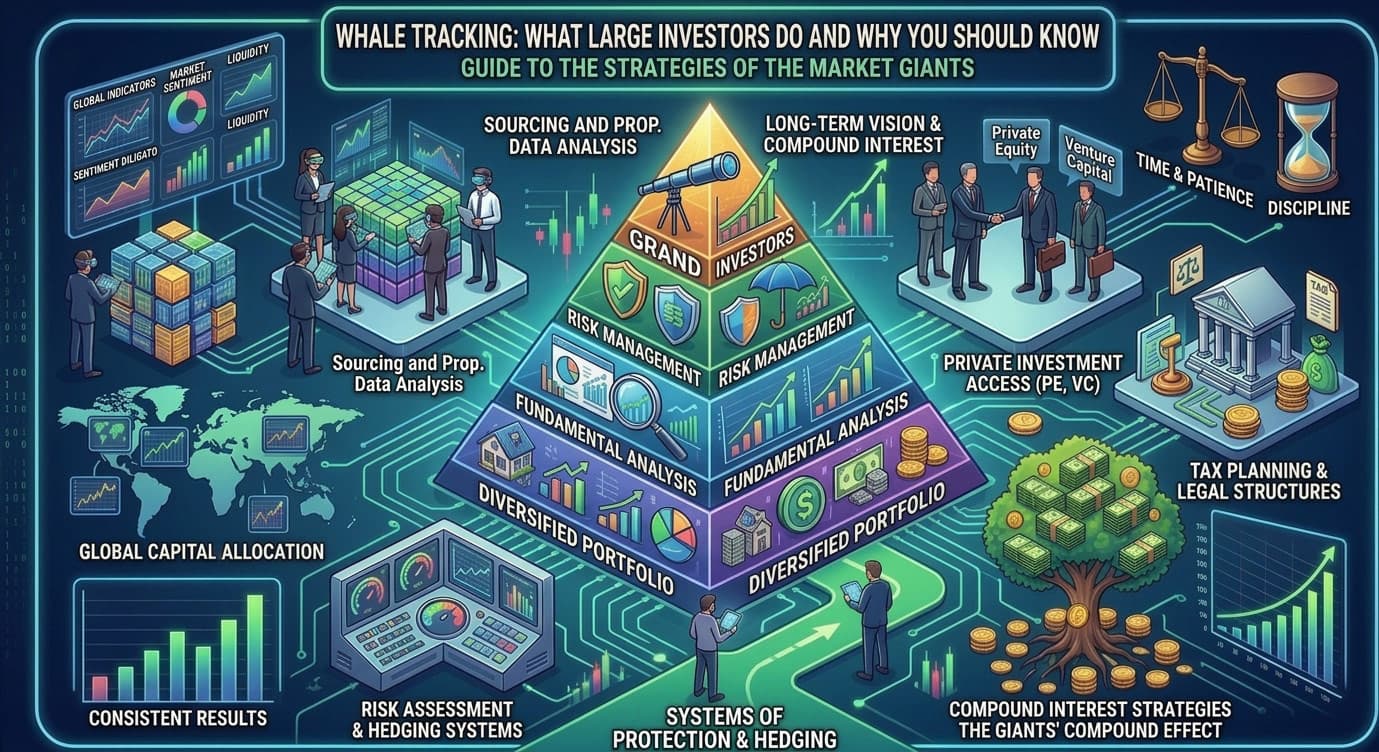
Whale Tracking: What Large Investors Do and Why You Should Know
In the world of cryptocurrencies, there exists a category of investors whose actions can move entire markets in minutes. They're known as "whales," and their behavior is one of the most underrated factors in determining crypto market cycles.
But what exactly are whales? How can you track their movements? And most importantly, how can you benefit from their behavior in your trading?
This article explores the whale tracking phenomenon, from the basics of on-chain analysis to practical strategies you can implement today.
Who Are Crypto Whales?
A "whale" is simply an investor who holds a significant amount of a cryptocurrency. There's no formal definition, but generally considered whales are:
- For Bitcoin: anyone holding 1,000+ BTC (over $30 million at April 2026 prices)
- For Ethereum: anyone holding 10,000+ ETH (over $25 million)
- For altcoins: the threshold depends on the project's market cap
Whales aren't necessarily individuals. They're more often:
- Exchanges: Binance, Kraken, Coinbase—which custody user funds
- Crypto investment funds: Three Arrows Capital, Grayscale, Pantera Capital
- Mining pools: entities that collect mining rewards
- Institutional portfolios: colleges, universities, foundations with crypto allocations
- Wealthy individuals: crypto entrepreneurs, project insiders, early adopters who accumulated enormous amounts years ago
Why Whales Matter
The obvious first question: why should you care what whales do?
1. They Create Market Volatility
A whale holding 5-10% of a mid-cap altcoin can move its price 20-30% with a single transaction. When a whale decides to sell—maybe for reasons completely unrelated to the project—the price crashes. Other traders, unaware of the whale, attribute the crash to "bad news" and panic sell.
Conversely, when a whale accumulates (buys), the price rises, and retail traders see the momentum and buy too, amplifying the movement.
Understanding whale movements lets you distinguish between "real trends" and "volatility caused by large orders."
2. They Anticipate Market Cycles
Whales, particularly smart ones (often ex-professional traders), accumulate during bear markets and sell during bull markets. They don't always follow crowd sentiment—they often do the opposite.
If you can recognize when whales are accumulating, you're potentially identifying the market bottom. If you notice whales selling massively, you might identify the top of a bull run.
This is one of the most reliable trading signals available—and the data is public on the blockchain.
3. They Signal Project Confidence
When a whale known for picking winners starts accumulating an obscure altcoin, it's a strong signal that the project might have merit. If the same whale sells completely, it's a sign they might not believe in the project anymore.
4. They Reduce Uncertainty
Operating based on pure speculation is stressful. Operating based on concrete data—like whale movements—reduces uncertainty and increases confidence in your decisions.
How On-Chain Analysis Works: The Basics
Whale tracking is based on a simple but powerful premise: all blockchain transactions are public. When a whale moves 1,000 Bitcoin from one wallet to another, the transaction is visible to anyone examining the blockchain.
Public and Pseudo-Anonymous Addresses
A blockchain address is a string of numbers and letters (for example: 1A1z7agoat5SFpxF8c7FbAx3W6yxwzW2J) that functions like a bank account on the blockchain. Unlike traditional bank accounts, these addresses:
- Are completely public
- Don't require personal identification to create
- Are permanent—all transactions remain forever
However, addresses are pseudo-anonymous. You don't directly know who owns 1A1z7agoat5SFpxF8c7FbAx3W6yxwzW2J, but with accumulated data, you can make educated guesses.
Labeled Wallets
For this reason, the crypto community created databases of known addresses. For example, we know that:
- Address X belongs to Binance (because Binance officially stated their funds are there)
- Address Y belongs to Grayscale (they published all their wallets)
- Address Z probably belongs to an unknown exchange (because transaction patterns match those of an exchange)
Services like Etherscan (for Ethereum) and Blockchain.com (for Bitcoin) maintain databases of these labeled and updated addresses.
Useful On-Chain Metrics
Not all transactions are equal. On-chain data lets you track:
Accumulation: are whales buying?
- If you see large amounts moving to addresses not associated with exchanges, they're probably purchases
- If addresses remain static (don't move for weeks), the whale is HODLing—a sign of project confidence
Distribution: are whales selling?
- If you see large amounts leaving whale addresses toward exchanges, they're probably sales
- The more whales selling simultaneously, the more selling pressure exists
Concentration: is it increasing or decreasing?
- If whales accumulate, concentration increases (fewer people control a larger percentage)
- If whales distribute funds, concentration decreases (ownership becomes more spread out)
Practical Tools for Whale Tracking
Now that you understand the concept, let's see the tools you can use to track whales.
1. Etherscan (for Ethereum and ERC-20 tokens)
Etherscan is the largest Ethereum blockchain explorer. It lets you:
- View all transactions
- Identify whale addresses
- See the complete history of an address
How to use it:
- Go to etherscan.io
- Search for an address, transaction hash, or token
- View all historical transactions
- Identify addresses with large balances
For example, searching "Ethereum whale" on Etherscan shows you a list of addresses with the largest Ethereum balances. You can click on one and see its recent movements.
Practical use case: If you're evaluating whether to buy a new ERC-20 token, you can search for it on Etherscan. If you see the top 10 addresses hold 90% of supply, that's a red flag (too much concentration, rug pull risk). If you see more balanced distribution, that's a better sign.
2. Blockchain.com (for Bitcoin)
Similar to Etherscan but for Bitcoin. It lets you view:
- Bitcoin transactions
- Addresses with large balances
- Fund flows between addresses
Unique feature: Blockchain.com shows Bitcoin distribution by balance range. You can immediately see: how many addresses hold 1-10 BTC? How many 100-1,000 BTC? How many 1,000-10,000 BTC?
This visualization gives you a sense of ownership distribution—critical for understanding whale sentiment.
3. Glassnode (Advanced On-Chain Analysis)
Glassnode is professional on-chain analysis. While basic explorers show you individual transactions, Glassnode aggregates data into useful metrics:
- Whale Transactions: number of transactions >1,000 BTC in recent days
- Large Holders: number of addresses holding >10,000 BTC and whether they're accumulating or distributing
- Exchange Outflows: how many Bitcoin are leaving exchanges (sign of accumulation)
- Exchange Inflows: how many Bitcoin are entering exchanges (sign of potential selling)
Glassnode isn't free, but it's the most reliable tool for advanced whale tracking.
4. Whale Alert (Twitter/Social Media)
Whale Alert is a Twitter account that tracks large transactions on the blockchain. When a significant transaction happens, a bot automatically posts a tweet.
For example: "🐋 1,000 BTC ($30M) transferred from unknown wallet to Binance 40 minutes ago"
Although there's a lot of noise (many whale transactions are simply repositioning, not sales), following Whale Alert gives you a real-time feed of significant movements.
5. IntoTheBlock (On-Chain Intelligence)
IntoTheBlock provides on-chain analysis dashboards including:
- Whale movements: track top holder movements
- Exchange flows: track Bitcoin/Ethereum inflows and outflows from exchanges
- Sentiment: analyze market sentiment based on on-chain data
It has a free version giving you access to basic metrics.
Practical Whale Tracking Strategies
Now we know the tools. How do you actually use them in your trading?
Strategy 1: Accumulation = Buying Opportunity
Signal: You see a whale (or multiple whales) massively accumulating a cryptocurrency.
What to do:
- Verify that accumulation is real (it's not just wealth moving from one whale address to another)
- Check if other whales are doing the same (consensus increases bottom probability)
- Look at the overall market sentiment—if fear is high (fear > 25) and whales are accumulating, it's often the bottom
- Accumulate yourself using dollar-cost averaging, not all at once
Why it works: Whales have resources to research projects well and decide intelligently. If they're accumulating during panic, they believe the price will rise. They're often right.
Strategy 2: Distribution = Selling Signal
Signal: A whale that has been accumulating for months suddenly starts selling.
What to do:
- Verify if it's a single large transaction (less concerning) or gradual distribution (more concerning)
- If the whale was accumulating and now sells, it's potentially a loss of confidence
- Note the price at which the whale is selling—if selling at a profit, it might mean the whale believes the price won't go higher
- Don't panic sell immediately, but gradually reduce your position
Caution: not all whales who sell do so because they believe the project will fail. They might simply need liquid cash. Examine the context.
Strategy 3: Exchange Flows as an Indicator
Signal: Large amounts of Bitcoin/Ethereum flowing out of exchanges.
Interpretation: When funds leave exchanges, it means people are moving them to personal wallets—they're HODLing, not selling.
Opposite signal: Large amounts flowing into exchanges.
Interpretation: When funds enter exchanges, it often means preparation for a sale.
Practical use: Track exchange flows for a few weeks. If you see a clear outflow trend (more exits than entries), selling pressure is low—it's a good time to accumulate. If you see inflow, selling pressure might be high.
Strategy 4: Cluster of Whales as Consensus
Signal: Don't follow a single whale, but look for consensus among multiple whales.
What to notice:
- If 3-5 independent whales are accumulating the same token, it's a stronger signal than 1 whale accumulating
- If the top 10 wallets of a token collectively increase their balance by 10%, that's significant
- If the top holder sells but other whales are still accumulating, the signal is mixed
Practice: Examine the list of top holders on Etherscan or Glassnode weekly. See if they're accumulating, distributing, or stagnant.
Whale Tracking and Your Investments
Suppose you use whale tracking to identify an opportunity. A known whale has started accumulating an altcoin you know about. How should you behave?
Don't Follow Blindly
Your first instinct might be: "The whale knows something I don't, I'll buy too!" Resist this instinct.
The whale might have information you don't, true. But they might also:
- Be a project insider (insider trading risk)
- Have a 5-year investment horizon (while you're thinking 5 months)
- Be casually diversifying their huge portfolio
Use Whale Tracking as Confirmation, Not as Primary Signal
Whale tracking is useful as confirmation of an investment thesis you already think is valid.
For example:
- You've researched an altcoin and believe the founder, technology, and use case have merit
- The price has recently fallen, sentiment is low
- You notice a known whale has started buying
- This whale tracking is NOT why you're investing, but it's confirmation that your original reasoning might be correct
Read our article on how to start crypto trading to understand how this fundamental research should underpin all your decisions.
Accumulate, Don't Speculate
If whale tracking gives you confidence in a project, the best approach is to accumulate gradually through dollar-cost averaging. Don't try to enter at the perfect price.
Use Saturia's alert system to set reminders when the price drops to certain levels, so you can do your regular DCA.
Whale Tracking Limitations
Whale tracking is powerful, but has important limitations to understand.
1. You Can't Know Intentions
When a whale sends Bitcoin to Binance, they probably intend to sell it. But it could also be internal fund reorganization, collateral relocation for a loan, or something else.
On-chain data tells you "what," but not always "why."
2. Whales Aren't Omniscient
Even whales make mistakes. A whale that massively accumulated a project that eventually fails loses as much as anyone else—just the absolute dollar amount is larger.
3. Front-Running Whale Tracking
With the growing popularity of whale tracking, whales themselves are aware their behavior is monitored. Some professional whales now use smaller amounts or more complex structures to hide their movements.
4. Exchange Custodial vs Non-Custodial
If a whale holds funds in a personal wallet, their behavior is trackable. But many whales keep their funds on exchanges (Binance, Kraken, etc.). The exchange doesn't disclose public addresses—funds remain "in the shadows," untrackable.
If we know Grayscale (a fund) is accumulating Bitcoin, we know it because they declare it publicly—not from whale tracking. Whale tracking is more useful for individual whales.
Whale Tracking Combined With Technical Analysis
Whale tracking is more powerful when combined with other signals.
For example:
- If a whale accumulates AND the price breaks a key resistance level (see technical analysis), the signal is stronger
- If whales sell BUT market sentiment remains positive, the selling signal is weak
Learn to triangulate data from:
- On-chain analysis (whale tracking)
- Technical analysis (resistances, supports, momentum)
- Sentiment (fear/greed, news, media)
- Project fundamentals (updates, adoption, competition)
Whale Tracking in Saturia
With Saturia, you can configure the system to automatically alert you when:
- A known whale buys or sells an asset you own
- Large amounts of funds enter/exit exchanges
- Ownership concentration changes significantly
The system integrates on-chain data with your personal portfolio, letting you see how whale movements might affect your assets.
Conclusion: Learn to Read the Whale Tracks
In crypto trading, the most sophisticated tools are often hidden in plain sight. Whale movements aren't secrets—they're publicly recorded on the blockchain.
Learning to read these movements won't make you rich by itself. But it will give you an informational advantage that most retail traders don't have.
Your next steps:
- This week: Create an account on Etherscan (if you use Ethereum). Browse some whale addresses. Learn how the interface works.
- Next two weeks: Follow Whale Alert on Twitter. Start getting a feel for what constitutes a "large transaction."
- Next month: Pick an asset you're interested in investing in. Track the whale holders using Etherscan. See if they're accumulating or distributing.
- Ongoing: Integrate whale tracking into your investment criteria, but not as the sole factor—use it as confirmation of deeper research.
The crypto market is transparent in an unprecedented way. Unlike traditional stock markets, where large institutional transactions remain hidden in dark pools, every whale move in crypto is visible. The question is: are you watching?
Start whale tracking today—and watch how this awareness transforms your trading decisions.