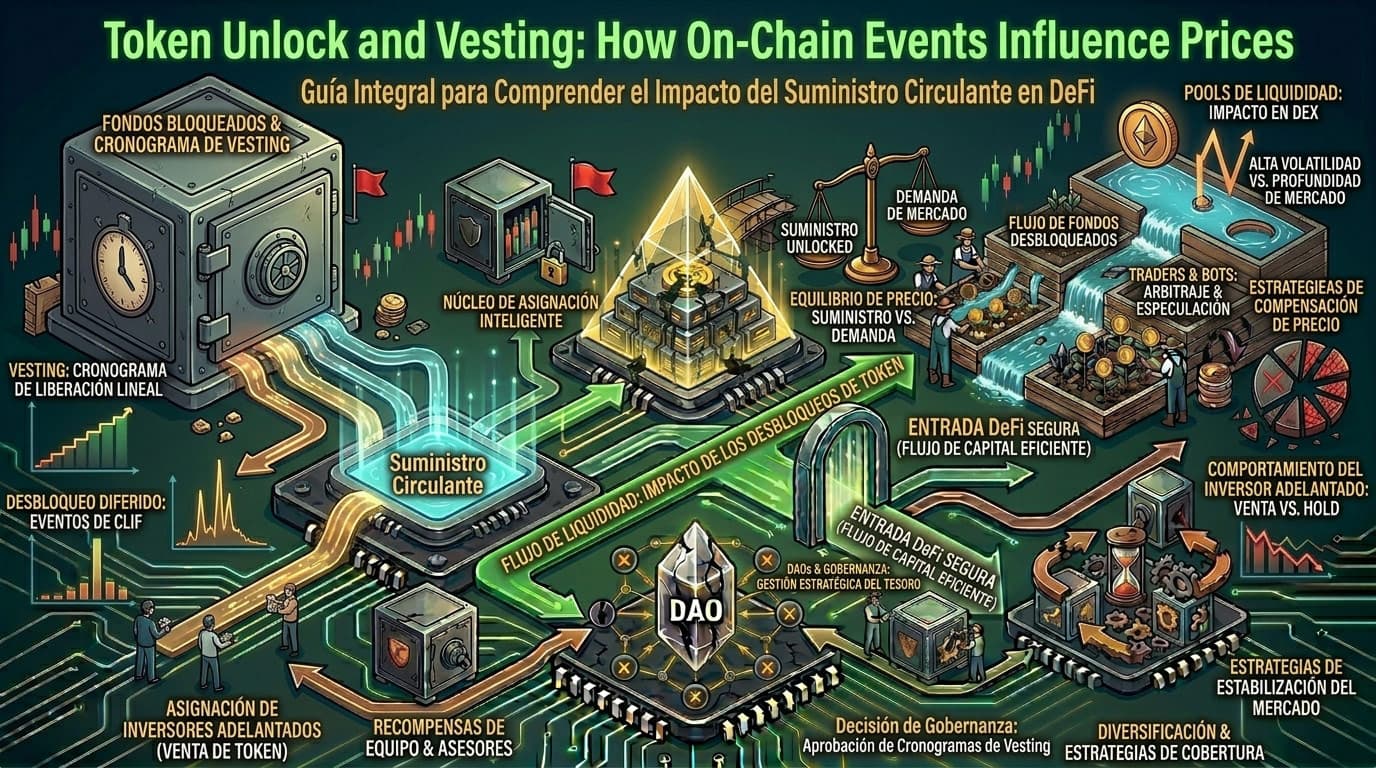
Token Unlock and Vesting: How On-Chain Events Influence Prices
If you've been trading crypto seriously, you've noticed that a token's price sometimes crashes suddenly for no apparent reason. Often, behind these price movements are token unlocks and vesting schedules - two of the most underrated but crucial factors for understanding market dynamics.
In this complete guide, you'll discover what vesting is, how token unlocks work, how to predict price impacts, and how to monitor them with Saturia.
What is Token Vesting?
Definition
Vesting is the process by which tokens are gradually unlocked and made available over time, instead of all being distributed immediately.
It's like a payment plan: instead of receiving 1,000 tokens today, you get them little by little over the following years.
Why Does Vesting Exist?
Vesting serves to:
- Protect Against Price Inflation: If all tokens were released simultaneously, supply would increase dramatically and price would crash
- Align Incentives: Team and investors have incentive to stay with the project long-term
- Build Trust: Investors see that the team is committed (can't run away with locked tokens)
- Controlled Distribution: Token launch is strategically scheduled
Who Has Vesting Tokens?
- Founders and team: Usually 20-40% of total supply
- Early investors: VC, seed investors, private sale
- Liquidity pool providers: Initial liquidity providers
- Mining/farming incentives: Rewards for early adopters
How a Vesting Schedule Works: Practical Examples
Linear Vesting (Most Common)
Imagine Saturia distributes 100 million SAT tokens:
Team vesting:
- 20 million tokens reserved for team
- Cliff period: 1 year (no unlock in first 12 months)
- Vesting period: 4 years
- Monthly release: 20M / (4×12) = ~417k tokens/month
Timeline:
- Months 0-12: 0 tokens unlocked
- Month 13: 417k unlocked
- Month 14: 417k unlocked (cumulative: 833k)
- Month 25: 417k unlocked (cumulative: 5M)
- Month 49: Final 417k unlocked, everything available
Tranche Vesting (By Step)
Instead of continuous monthly release, tokens unlock in tranches:
- Year 1: 5M tokens (25%)
- Year 2: 5M tokens (25%)
- Year 3: 5M tokens (25%)
- Year 4: 5M tokens (25%)
Major unlock milestones:
- January Year 1: unlock 5M
- January Year 2: unlock 5M
- January Year 3: unlock 5M
- January Year 4: unlock 5M
Vesting with Acceleration
Some vesting accelerates if milestones are reached:
- Base vesting: 10% annually
- If token reaches 10x launch price: +50% acceleration
- If project reaches 10M users: +25% acceleration
This incentivizes project growth.
Token Unlock: What It Is and Price Impact
Difference Between Vesting and Unlock
- Vesting: Period during which tokens are locked and slowly unlocked
- Unlock: Specific moment when a large quantity of tokens becomes available
An unlock is like a discrete event; vesting is a continuous process.
How an Unlock Works
Scenario: Huobi Exchange has 50 million HT tokens in vesting. The vesting schedule states:
- Every month 1M HT unlocks
- Every 6 months a major tranche of 10M unlocks
When day "X" arrives and the 10M unlocks, that's a token unlock event.
Price Impact of an Unlock
When tokens unlock, supply increases massively. If demand stays constant:
Price ∝ Demand / Supply
If Supply ↑ and Demand remains constant, Price ↓
Case Study: Aptos (APT) Unlock Crash in 2023
Before the unlock (February 2023):
- APT trading at $16 USD
- Positive sentiment
- Active development
The unlock event:
- 200 million tokens unlocked from investors and team
- Represented 50% of circulating supply
- Massive dumping of tokens on market
After the unlock:
- APT crashes to $7-8 USD (50% down)
- Slowly recovers over following months
- Remains volatile until inflation stabilizes
Impact Statistics
Research shows:
- Average price decline: -10% to -30% on unlock day
- Volatility increases 2-3x in the week of the event
- Recovery happens in 3-6 months if project fundamentals are solid
- Weak projects continue downtrend post-unlock
Not all unlocks result in crashes, but the risk is real.
Factors That Influence Unlock Impact
Quantity of Tokens Unlocked
- < 5% of supply: Minor impact
- 5-20% of supply: Significant impact
- > 20% of supply: Likely crash
Category of Token Unlocked
Team unlock = MAXIMUM RISK
- They might sell to cash out
- Incentive to realize profits
Investor unlock = HIGH RISK
- VC and seed investors sell after ROI
- Quick scalping for profits
Community/incentives unlock = LOWER RISK
- Long-term holders
- Less selling pressure
Market Conditions
Bull market:
- New buyers absorb unlocked tokens
- Price impact more contained
- May not affect rally
Bear market:
- Nobody wants to buy
- Massive dumping from those unlocking
- Accelerated crash
Sideways market:
- Effect more pronounced
- High volatility
- Hard to predict outcome
Sentiment and News
If at the same time as unlock there are:
- Price impact decreases or disappears
- Positive news: Bridge with major blockchain, partnership, technical upgrade
- Impact amplifies, worse crash
- Negative news: Hack, regulation, technical issue
Market Liquidity
- High liquidity: Unlock absorbed better, less impact
- Low liquidity: More dramatic crash, high slippage
How to Predict Important Unlocks
Research Strategies
1. Consult the Project Whitepaper
- "Token Allocation" section specifies vesting schedule
- Calculate unlock dates
- Identify major milestones
2. Specialized Tracking Sites
- Messari: Provides detailed vesting schedules
- Token Unlock Calendar: Calendar with impact estimates
- Coingecko: Shows project inflation over time
3. Blockchain Explorer
- Etherscan/Polygonscan for Ethereum/Polygon
- Check vesting contracts
- See how much has already been unlocked
4. Social Media and News
- Official announcements from project
- Community pre-warns of important unlocks
- Influencers often alert to risks
Red Flags to Look For
- Vesting schedule too short: 1-2 years for team = very high dumping velocity
- High percentage of team tokens: > 30% = massive dilution
- Undisclosed imminent unlock: Transparency is important
- Zero cliff: All release on day one = guaranteed crash
Trading Strategy Around Unlocks
Before the Unlock (2-4 Weeks Before)
Option 1: Avoid
- Exit position completely
- Wait for crash, then re-enter
- Minimize risk
Option 2: Hedging
- Reduce position by 50%
- Preserve upside potential
- Limit downside
Option 3: Short/Derivatives
- If advanced, take a short position
- Profit from crash
- Highly risky
On the Unlock Day
Don't trade:
- Maximum volatility
- Excessive slippage
- Positions liquidate easily
If you must trade:
- Reduce size by 70%
- Use limit orders (no market orders)
- Keep TP/SL very tight
After the Unlock (Days-Weeks Later)
If there's a crash:
- Wait for panic selling to end
- 3-5 days of liquidation
- Then identify support levels and re-enter
If price resists:
- Could mean solid fundamentals
- Less dumping pressure
- Opportunity for long-term
Case Study: LIDO (LDO) Unlock May 2024
Background:
- Lido is the leading liquid staking protocol
- Market cap ~$3 billion
- LDO tokens in vesting for 4 years
The event:
- 50 million LDO unlocked (represented ~5% of circulating supply)
- Primarily team unlock
- Pre-unlock price: $6.50 USD
Actual impact:
- Unlock day: -8% (LDO to $5.97 USD)
- Unlock week: -12% overall
- Recovery: 2 weeks to $6.00 USD
- 2 months later: Return to $6.80 USD
Lesson: Even strong protocols see temporary declines. It's not the end of the project.
How Saturia Helps Monitor Unlocks
Saturia provides specialized tools for tracking token unlocks:
Crypto Calendar
- View all upcoming token unlocks
- Filter by date, category (team, investor, community)
- Automated notifications 7 days before event
- Price impact estimates based on historical models
Price Impact Analysis
- Historical analysis: How much did price crash for similar unlocks?
- Supply projection: Calculate new supply after event
- Demand forecast: Estimate if there's enough buyer pressure
Alert System
- Impending unlock alerts: Warning 1 week before
- Price movement alerts: Notify if token rises in anticipation
- Post-unlock monitoring: Track recovery and identify opportunities
Monitoring Dashboard
- Vesting status: Graphically view vesting schedule
- Unlock timeline: Calendar with important dates
- Portfolio exposure: How many of your investments are exposed to unlocks?
Differences Among Major Protocol Vesting
Protocols with Aggressive Vesting (High Risk)
- Uniswap (UNI): 4 years vesting, but fast distribution to incentives
- Aave (AAVE): 4 years team vesting but investors unlock earlier
- Compound (COMP): Continuous release to users
Protocols with Conservative Vesting (Low Risk)
- Ethereum (ETH): No vesting, already fully distributed pre-2020
- Bitcoin (BTC): Gradual mining, no brutal unlock events
- Cosmos (ATOM): Very slow vesting, uniform distribution over time
Token Unlock Impact Calculator
Simple impact estimation:
``` New Supply = Old Supply + Unlocked Tokens Supply Growth % = (Unlocked Tokens / Old Supply) × 100
Minimum Impact = -Supply Growth % Actual Impact = -Supply Growth % × volatility factor (1.5-3x) ```
Example:
- Current supply: 1 billion
- Tokens unlocking: 200 million
- Growth: (200M/1B) × 100 = 20%
- Minimum impact: -20%
- Actual impact: -20% × 2 = -40% (worst case)
How to Protect Your Portfolio From Unlocks
Strategy 1: Diversification
- Don't put everything in a token with imminent unlock
- Spread across 5-10 tokens with staggered vesting
Strategy 2: Active Monitoring
- Use Saturia to track unlocks
- Receive alerts in advance
- Enough time to plan exit
Strategy 3: Strategic Positioning
- Accumulate during post-unlock dump
- As long as fundamentals are solid
- Sell before next unlock
Strategy 4: Stablecoin Hedge
- Keep 20-30% of portfolio in USDC/USDT
- Can quickly enter during dumps
- Not forced to sell when price drops
Conclusion
Token unlocks and vesting schedules are critical price-influencing factors, but often ignored by retail investors. Many losses could have been avoided with simple understanding of these concepts.
Key takeaways:
- Always check vesting schedule before investing
- Team unlocks are riskier than community unlocks
- Larger percentage unlocked = greater risk
- Bull market absorbs unlocks better than bear market
- Monitor with Saturia to not miss warning signs
Once you understand how unlocks work, you can:
- Avoid disastrous timing
- Identify accumulation opportunities
- Protect your portfolio
Learn how to read crypto charts
Checklist for Monitoring Unlocks
- I've checked vesting schedules for my main investments
- I know the date of the next major unlock
- I understand what percentage of supply will unlock
- I have a plan for unlock day (hold, exit, partial)
- I've enabled alerts on Saturia
- I've diversified my portfolio
- I maintain a buffer in stablecoins for opportunities
- I'll monitor post-unlock recovery
Start tracking unlocks today with Saturia - our integrated crypto calendar will alert you to all important on-chain events before they impact your portfolio.