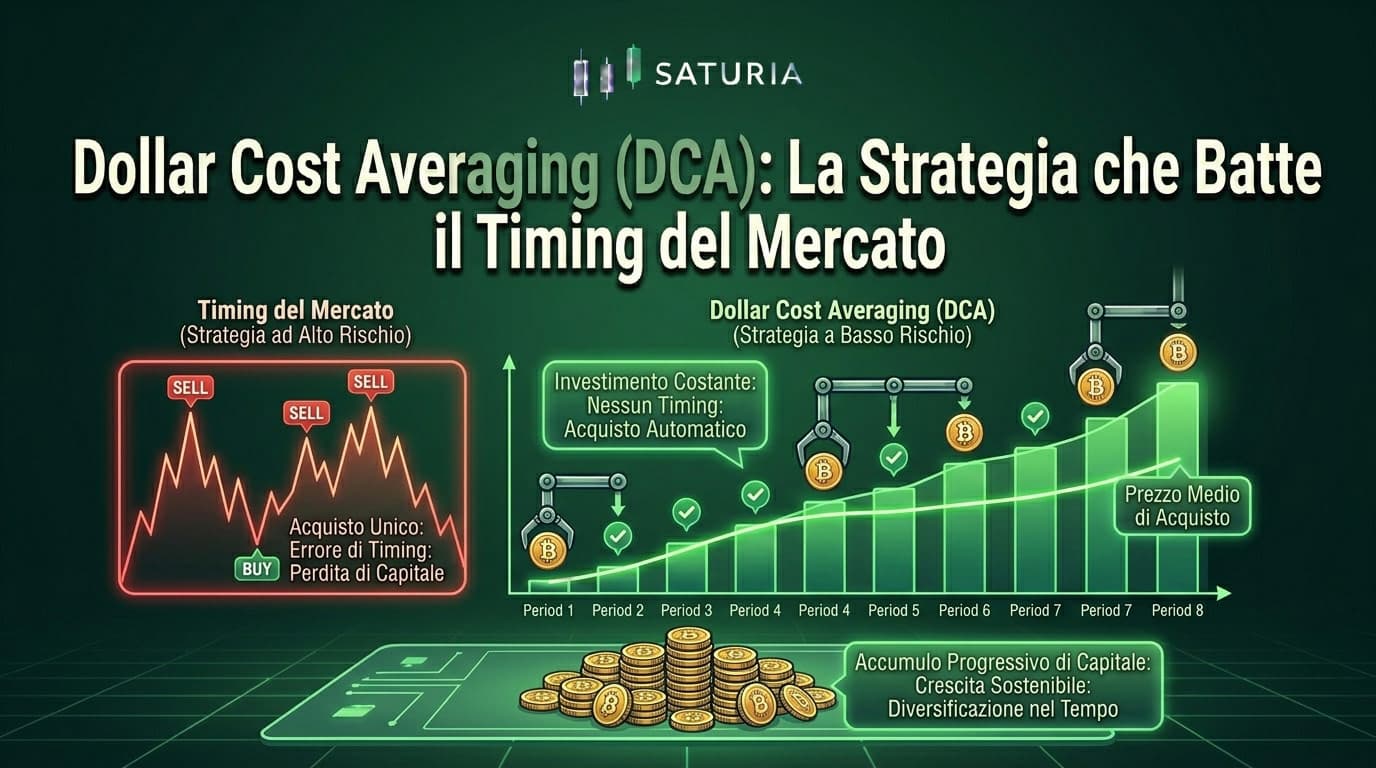
Dollar Cost Averaging (DCA): La Strategia che Batte il Timing del Mercato
Se c'è una strategia che garantisce il massimo numero di vittorie per il minimo sforzo mentale nel crypto, è il Dollar Cost Averaging (DCA).
Non è affascinante. Non ti farà guadagnare il 50% in una settimana. Ma è provato, matematicamente solido, e funziona per il 99% degli investitori. Mentre altri si tormentano cercando il momento perfetto per comprare, tu accumuli tranquillamente nel tempo e vedi il tuo portafoglio crescere in modo coerente.
In questa guida, ti mostrerò esattamente cosa è il DCA, perché funziona, come implementarlo, e come storicamente ha generato rendimenti superiori rispetto ai tentativi di "timing del mercato".
Cos'è il Dollar Cost Averaging?
Il Dollar Cost Averaging (DCA) è semplicemente questo: investire una quantità fissa di denaro a intervalli regolari, indipendentemente dal prezzo corrente dell'asset.
Invece di investire €10.000 in Bitcoin oggi sperando che il prezzo salga, tu:
- Investi €1.000 al mese per 10 mesi
- Oppure €500 ogni due settimane
- Oppure €100 ogni settimana
La bellezza del DCA è che elimina completamente il problema del timing. Non devi preoccuparti se il prezzo sta per salire o scendere. Continui semplicemente a investire l'importo fisso, e il mercato farà il suo corso.
L'Analogia dell'Autobus
Immagina di aspettare un autobus che cambia prezzo ogni giorno:
- Giorno 1: €2 per ticket
- Giorno 2: €3
- Giorno 3: €1.50
- Giorno 4: €2.50
Se compri 1 ticket al giorno (DCA):
- Spendi €2 il giorno 1 (1 ticket)
- Spendi €3 il giorno 2 (1 ticket)
- Spendi €1.50 il giorno 3 (1 ticket)
- Spendi €2.50 il giorno 4 (1 ticket)
- Totale speso: €9 | Totale ticket: 4 | Prezzo medio: €2.25
Se invece aspetti il giorno 3 pensando fosse il minimo e compri 4 ticket a una volta:
- Spendi €6 (4 × €1.50)
- Poi il prezzo sale a €3 e sei furioso di non aver comprato anche il giorno 4
Il DCA ti protegge dalle decisioni sbagliate sui tempi. È quasi impossibile perdere denaro significativamente con il DCA su un asset che sale a lungo termine.
Perché il DCA Funziona Matematicamente
Il DCA funziona perché sfrutta una proprietà matematica fondamentale: quando i prezzi sono bassi, compri più unità; quando i prezzi sono alti, compri meno unità.
Esempio Numerico Dettagliato:
Scenario: Investi €1.000 al mese in Bitcoin per 6 mesi
| Mese | Prezzo BTC | Investimento | BTC Acquistati |
|---|---|---|---|
| 1 | €30.000 | €1.000 | 0.0333 |
| 2 | €35.000 | €1.000 | 0.0286 |
| 3 | €25.000 | €1.000 | 0.0400 |
| 4 | €28.000 | €1.000 | 0.0357 |
| 5 | €32.000 | €1.000 | 0.0313 |
| 6 | €40.000 | €1.000 | 0.0250 |
| Totale | - | €6.000 | 0.1939 BTC |
Prezzo medio del DCA: €6.000 ÷ 0.1939 = €30.945
Noti qualcosa? Anche se il prezzo finale (€40.000) è sopra il prezzo medio, il tuo prezzo di acquisto medio è €30.945, non €30.000 (il primo prezzo) o €40.000 (l'ultimo).
Ora, confronta con il "Lump Sum" (acquisto tutto in una volta):
Scenario: Investi €6.000 al mese 1 a €30.000
- Acquisti: 6.000 ÷ 30.000 = 0.20 BTC
- Prezzo medio di acquisto: €30.000
Se il prezzo scende a €25.000, il DCA (0.1939 BTC) è meno male perché ha comprato a prezzi diversi. Se il prezzo sale a €40.000, il lump sum (0.20 BTC) guadagna più dell'DCA in termini assoluti... ma entrambi vincono. Il DCA semplicemente vince "meno", ma con molto meno stress.
Il Vantaggio Statistico
La ricerca accademica (incluso uno studio di Vanguard) ha dimostrato che:
- Il lump sum outperforms il DCA nel 66% dei casi
- Ma il DCA ha una varianza molto più bassa (meno downside risk)
- Il DCA vince nel 34% dei casi, spesso in grandi crolli
In altre parole, il lump sum è leggermente superiore in media, ma il DCA ha meno perdite nei cattivi scenari. Per chi non può emotivamente tollerare una perdita del 30% nel primo mese, il DCA è psicologicamente superiore.
DCA vs Lump Sum: Quando Quale Strategia?
Usa il Lump Sum Se:
- Hai una grande somma in cassa che "sa" di essere una follia non investire
- Puoi emotivamente tollerare una perdita immediata del 30-40%
- Sei entrato in mercato consapevolmente al "massimo"
- Hai orizzonte temporale > 10 anni
- La tua strategia è puro hodling
Esempio: ricevi un'eredità di €100.000. Investire tutto in una volta, anche se il timing è cattivo, è probabilmente meglio di lasciare i soldi in cassa.
Usa il DCA Se:
- Hai stipendio mensile/regolare che vuoi investire
- Sei emotivamente sensibile alle perdite
- Vuoi eliminare il rischio di timing
- Sei principiante e vuoi costruire fiducia
- Sei un investitore passivo che vuole semplicità
- Il tuo orizzonte temporale è 3-7 anni
Esempio: decidi di investire il 10% del tuo stipendio mensile in crypto. Il DCA è perfetto.
DCA nel Mondo Reale: Dati Storici
Analizziamo un caso storico reale: Bitcoin dal 2017 al 2024.
Scenario 1: Lump Sum a Gennaio 2018 (il picco)
- Prezzo: €11.000 (appena dopo il massimo di €19.000 del Dicembre 2017)
- Investimento: €12.000
- BTC acquistati: 1.09 BTC
- Marzo 2024: prezzo ~€40.000
- Guadagno: 270% (~€33.000 di profitto)
Sì, anche chi ha comprato letteralmente al picco del 2017 ha fatto enormi profitti entro 6 anni. Ma il viaggio era terribile—nel 2018 era in perdita del 50%, e ci sono voluti 3-4 anni per recuperare.
Scenario 2: DCA da Gennaio 2018 a Dicembre 2024 (€100/mese)
- Investimento totale: €8.400 (84 mesi × €100)
- BTC acquistati: ~0.38 BTC (con prezzo medio di circa €22.000)
- Marzo 2024: prezzo ~€40.000
- Guadagno: 73% (~€6.100 di profitto)
Interessante no? In questo scenario, il lump sum vince significativamente. Ma il viaggio per il DCA era psicologicamente molto più facile—non ha mai avuto una grande perdita iniziale.
Scenario 3: DCA da Giugno 2022 a Marzo 2024 (€100/mese)
- Giugno 2022: prezzo ~€19.000
- Marzo 2024: prezzo ~€40.000
- BTC acquistati: ~0.08 BTC (con prezzo medio di circa €25.000)
- Guadagno: 60% (~€480 di profitto)
Se avessi fatto lump sum a Giugno 2022, avresti comprato a il minimo (lucky timing). Con il DCA, non hai preso il minimo perfetto, ma sei comunque salito 60% in 22 mesi.
Come Implementare il DCA: La Guida Pratica
Passo 1: Decidi la Frequenza
- Settimanale: maggior numero di acquisti (meno rischio di timing), ma più commissioni
- Bisettimanale: equilibrio
- Mensile: meno commissioni, comunque efficace
La ricerca suggerisce che la frequenza importa meno della consistenza. Se puoi permetterti settimanale, fallo. Se mensile è più pratico, va benissimo comunque.
Passo 2: Decidi l'Importo
Deve essere un importo che puoi permetterti di "perdere" nel senso che, se il prezzo cade il mese prossimo, non andrai in panico. Se non puoi permetterti la volatilità, l'importo è troppo alto.
Esempio:
- Stipendio mensile: €3.000
- Tassa totale (casa, cibo, ecc.): €2.500
- Avanzi: €500
- Puoi dedicare il 50% al DCA in crypto: €250/mese
€250/mese × 12 = €3.000/anno. Non è una quantità enorme, ma nel corso di 10 anni diventa €30.000 + i guadagni sugli investimenti.
Passo 3: Automatizza
Questo è il segreto. Non affidarti alla disciplina umana. Usa:
- Exchange DCA automatico: Kraken, Coinbase e molti exchange permettono acquisti ricorrenti automatici
- Bot DCA: servizi che automatizzano per te (es., DCA.bot)
- Reminder + acquisto manuale: se no automatico è disponibile, imposta un reminder
Passo 4: Diversifica il Tuo DCA
Non investire il 100% in un singolo asset. Ad esempio, se investi €250/mese:
- €150 in Bitcoin
- €80 in Ethereum
- €20 in altcoin diversi
Questo applica il DCA a un portafoglio bilanciato.
Passo 5: Non Interrompere il DCA
Questo è dove la maggior parte fallisce. Durante i bear market, è tentante interrompere il DCA "finché il prezzo non sale". Non farlo. Durante i bear market il DCA è più potente che mai—stai comprando quantità maggiori di asset a prezzi bassi.
I maggiori vincitori del DCA sono coloro che hanno continuato durante 2018, 2022, e altri anni cattivi.
DCA e Saturia: Ottimizzazione della Strategia
Con Saturia, puoi implementare il DCA in modo ancora più intelligente:
- Portfolio Targets: definisci le allocazioni target (es., 50% BTC, 30% ETH, 20% altcoin)
- Automated Rebalancing: dopo ogni DCA, Saturia può automaticamente allocare gli acquisti proporzionalmente
- Performance Tracking: monitora come il tuo DCA sta performando vs la media di mercato
- Cost Basis Tracking: Saturia traccia automaticamente il costo di acquisto medio, visualizzando il tuo vantaggio/svantaggio
Non devi fare calcoli complicati—Saturia fa tutto per te.
Domande Frequenti sul DCA
D: Se compro via DCA e il prezzo crolla il mese prossimo, che faccio? A: Continui a comprare. È il momento in cui il DCA brilla di più. Stai comprando a sconti enormi.
D: Il DCA funziona per altcoin o solo per Bitcoin/Ethereum? A: Il DCA funziona per qualsiasi asset che credi avrà valore a lungo termine. Tuttavia, il DCA è meno efficace per asset ad altissimo rischio (small cap altcoin che potrebbero andare a zero).
D: Devo fare DCA anche durante bear market? A: Assolutamente sì. In realtà, il DCA durante i bear market è quando accumuli il massimo valore. Se smetti durante i bear market, stai facendo il contrario della filosofia del DCA—stai vendendo paura.
D: Qual è l'importo minimo per il DCA? A: Tecnicamente, anche €10/settimana funziona. Dipende dalle commissioni—se le commissioni sono il 1%, non ha senso fare DCA su €10 (commissione di €0.10 è il 1%). Ma su un importo come €100+/mese, le commissioni sono negligibili.
D: Per quanto tempo devo fare DCA? A: Idealmente, per 3-10 anni. Quanto più lungo, tanto meglio. Se fai DCA per 30 anni, è praticamente impossibile non aver guadagnato significantly.
D: Il DCA è tassato diversamente? A: Sì. Molti paesi tassano le plusvalenze a lungo termine in modo più favorevole. Verificare le leggi locali, ma il DCA spesso beneficia di un trattamento fiscale superiore rispetto al trading attivo.
La Psicologia Vincente del DCA
Il vero vantaggio del DCA è psicologico. Non è nelle formule matematiche—è nel tuo cervello.
Quando fai DCA:
- Non sei mai nervoso se il prezzo cade, perché sai che stai comprando a prezzi migliori il mese prossimo
- Non hai FOMO se il prezzo sale, perché sei già long-term oriented
- Non prendi decisioni emotive perché la decisione è automatizzata
- Dormi meglio la notte perché non stai cercando di cronometrare il mercato
Il timing del mercato ha un costo psicologico enormedito in ricerca—gli investitori attivi hanno livelli di stress molto più alti. Il DCA è la strategia "stress-free" dell'investimento.
Strategie Avanzate di DCA
Una volta che padroneggi il DCA base, puoi implementare varianti:
DCA Dinamico
Aumenta l'importo di DCA durante i bear market quando i prezzi sono bassi. Diminuisci durante i bull market quando i prezzi sono alti. Questo amplifica i guadagni senza richiedere timing perfetto.
DCA con Rebalancing Automatico
Ogni mese, dopo il DCA, ribalancia il portafoglio alle allocazioni target. Questo combina i vantaggi del DCA con quelli del rebalancing periodico.
DCA Deterministico
Invece di DCA basato su importo fisso, usa DCA basato su "compra X unità al mese". Durante i bull market compri meno denaro in bitcoin (es., 0.001 BTC), durante i bear market compri meno Bitcoin in denaro. Questo riduce ulteriormente il rischio.
Conclusione: Il DCA è la Strategia per la Maggior Parte
Se non sei un trader esperto che può passare ore analizzando chart e price action, il DCA è probabilmente la migliore strategia per te.
Il DCA:
- ✓ Elimina il timing del mercato
- ✓ Riduce la volatilità percepita
- ✓ È semplice da implementare
- ✓ È automatizzabile
- ✓ Ha comprovata traccia di successo storica
- ✓ È psicologicamente meno stressante
La ricerca mostra che il 90% dei trader attivi underperform il semplice DCA. Non cercare di battere il mercato—accumulare sistematicamente tramite DCA e hodla pazientemente è la strada verso la ricchezza nel crypto.
Con Saturia, il DCA diventa ancora più facile: traccia il tuo costo di acquisto medio, monitora le performance, e ottimizza automaticamente l'allocazione. Inizia il tuo DCA oggi—non c'è momento migliore di adesso per cominciare.
Questo articolo è solo educazionale. Non è consiglio finanziario. Fai le tue ricerche e consulta un consulente finanziario indipendente prima di investire in criptovalute.